Last Updated: 2026-11-06 · Written by the NAIJI Electric engineering team. We build medium voltage switchgear and the SLVA low voltage switchgear line. Where a figure below is a NAIJI rating, we say so. Everything else is a vetting rule you can apply to any LV panel supplier.
Key Takeaways
- Vet the panel system, not the brochure: ask for IEC 61439 design-verification evidence for the exact system being quoted.
- Compare quotes on Icw (kA/1 s), busbar current, form of separation and breaker brand. Busbar amps alone hide most of the price difference.
- Ask for the routine-verification record for your own panels, and witness a factory acceptance test on the first order.
Quick Answer: How to Vet a Low Voltage Switchgear Manufacturer
Vet low voltage switchgear manufacturers in this order: (1) confirm which standard the panel system is built to (IEC 61439-1/-2 for export, GB/T 7251 in China) and who holds the design verification; (2) check the rated values that decide safety, especially short-time withstand current and busbar ratings; (3) confirm the form of internal separation and IP rating; (4) agree the brand and ratings of the main breakers; (5) check engineering support, drawings and the routine tests on your panels; (6) agree packing, documentation and spare parts before you place the order.
This guide is for buyers who already know they need an LV main distribution panel, motor control centre or power-factor correction panel. If you are still deciding between LV and MV distribution, start with our LV vs MV switchgear guide. If you are vetting a medium voltage supplier, use our MV switchgear manufacturer checklist instead.
Step 1: Check the Standard and Who Verified the Design
IEC 61439 separates two roles. The original manufacturer designs the panel system and carries out its design verification. The assembly manufacturer builds your panels from that system and carries out routine verification. Sometimes they are the same company, and sometimes a local panel shop builds under licence from a system owner. Either can be fine. What matters is that the evidence covers the system you are buying.
| Evidence | What it proves | What to ask for |
|---|---|---|
| Design verification (IEC 61439-1/-2) | The panel design meets the standard: temperature rise, short-circuit withstand, dielectric properties, clearances, protective circuit and more | The report for the exact system and rating quoted, and how each item was verified: by test, by comparison with a tested reference design, or by assessment |
| Routine verification | Your panels were built correctly | The routine-verification record for each panel, signed before shipment |
| Component documentation | Breakers, contactors and meters meet their own product standards | Data sheets and certificates for the installed brand and frame size |
| Market approvals | Local acceptance where required | Whatever your utility or authority asks for. Check this early, not at the shipping stage. |
A red flag is a supplier that shows a certificate for a different panel type, a different rating or a different company name than the one on the quote.
Step 2: Compare the Ratings That Decide Safety and Price
Two LV panels with the same main busbar current can differ a lot in copper, enclosure strength and price. Put these values side by side for every supplier:
| Rating | Why it matters | NAIJI SLVA (per product data sheet) |
|---|---|---|
| Rated insulation voltage / system voltage | Must suit the network, e.g. 230/400 V | 690 V insulation; 230/400 V AC system |
| Rated frequency | 60 Hz networks need ratings confirmed at 60 Hz | 50 Hz |
| Main (horizontal) busbar current | Sized to the transformer and future load | 1250 / 2000 / 2500 A |
| Vertical (distribution) busbar current | Limits how much load one section can carry | 1250 / 1600 A |
| Rated short-time withstand current (Icw) | Must cover the prospective fault current at the panel for the protective device's clearing time (check peak withstand Ipk too), unless the design relies on a verified conditional rating (Icc) with a specified current-limiting device | 35–65 kA / 1 s |
| Functional unit (drawer) ratings | Sets the largest outgoing feeder in a draw-out unit | 250 A / 400 A drawers |
| Overvoltage category / pollution degree | Insulation design for the installation | Category IV / degree 3 |
| Installation conditions | Altitude and temperature derating | Indoor, −5 °C to +40 °C, ≤2000 m |
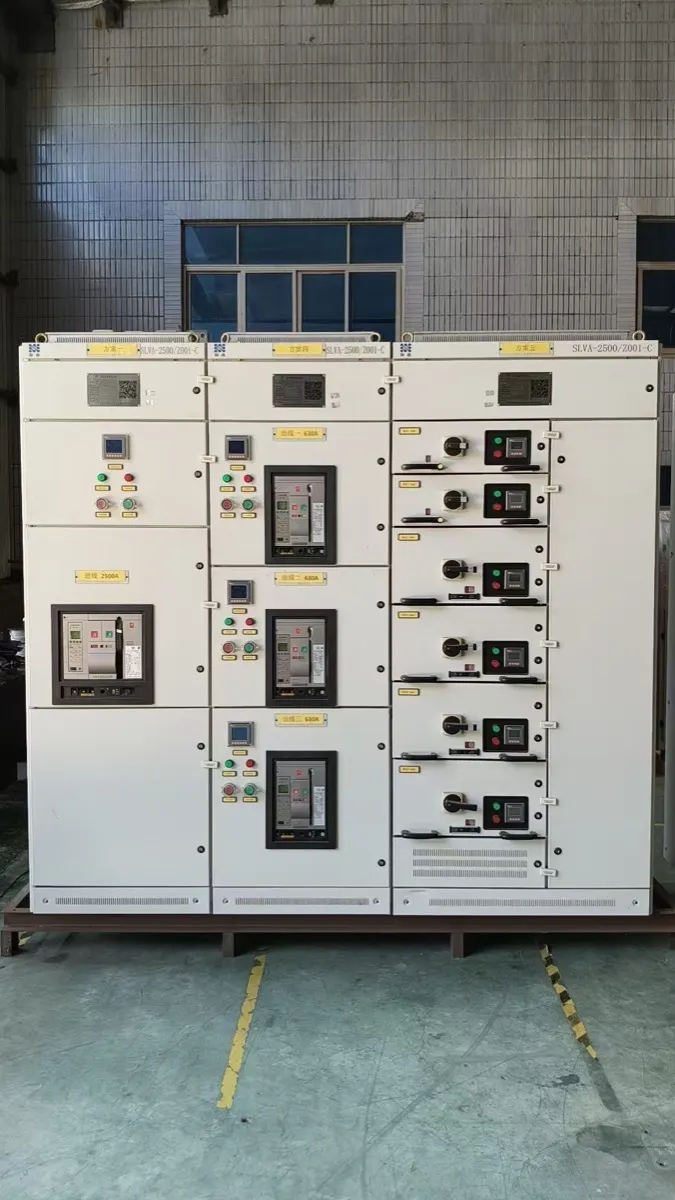
The SLVA line matches transformers of 630, 800, 1000 and 1250 kVA and comes in eight standardized structural schemes (incoming, bus coupler, feeder and reactive power compensation panels), in general and compact cabinet widths. Full specifications are on the SLVA low voltage switchgear page.
The most common mistake is buying on busbar amps alone. Calculate the fault level at the panel from the transformer rating and impedance, then put the required short-circuit rating in the RFQ: Icw with its duration and Ipk, or a conditional rating (Icc) together with the protective device it was verified with. Our busbar sizing guide explains how busbar current and withstand ratings relate.
Step 3: Form of Separation, IP Rating and Arc Behaviour
IEC 61439-2 defines forms of internal separation from Form 1 (no internal separation) to Form 4 (busbars, every functional unit and every outgoing terminal separated). A higher form costs more steel and space, and it reduces the risk of contact with live parts when one functional unit is isolated, which is why it is often specified where feeders must be serviced while the rest of the board stays energised. It does not by itself make live working safe: isolation procedures and a task-specific risk assessment still apply. For critical loads such as hospitals, data centres and process plants, specify the form you need in writing. Do not accept "segregated" without a form number.
- IP rating (IEC 60529): state it for the doors closed, and for the doors open if operators will work on live boards.
- Internal arc: IEC TR 61641 is the test guide for LV assemblies under arcing conditions. If arc-fault performance is part of your specification, ask whether the panel system was tested to it and at what current and duration. See our arc flash protection guide for the wider picture.
- Draw-out vs fixed: draw-out functional units, as on the SLVA line, cut downtime when a feeder fails. Fixed panels are cheaper where downtime is less critical.
Step 4: Agree the Breaker Brand and Ratings
The air circuit breakers (ACBs) and moulded-case circuit breakers (MCCBs) inside an LV panel are often the largest single cost item. Suppliers can usually fit the brand you specify, or offer alternatives at a lower price. In the RFQ, state for each incomer and feeder:
- Breaker type (ACB or MCCB), brand and frame size.
- Rated current and ultimate / service breaking capacity (Icu / Ics).
- Trip unit type and protection settings needed.
- Accessories: motor operator, shunt trip, auxiliary contacts, communication module.
Ask whether the design-verification evidence covers the chosen breakers in that panel. A main breaker swap can change temperature rise and short-circuit performance. For the ACB/MCCB choice itself, see ACB vs MCCB.
Step 5: Check Engineering, Testing and Documentation
| Area | What a capable LV panel supplier provides |
|---|---|
| Engineering | Single-line diagram review, general arrangement and wiring drawings for approval before production |
| Busbar and enclosure work | Clear statement of busbar material and cross-section, and enclosure sheet thickness and finish |
| Testing | Routine verification on every panel; a factory acceptance test (FAT) you can witness in person or by video |
| Documentation | As-built drawings, test records, component list and manuals in your language |
| Packing and spares | Shipping splits that match your site access, seaworthy packing, recommended spare drawers and breakers |
For the test sequence and what to witness, use our switchgear FAT and SAT guide.
LV Switchgear RFQ Checklist (Copy Into Your Inquiry)
| # | Parameter | Your value |
|---|---|---|
| 1 | System voltage, frequency and earthing system (e.g. 400 V, 50 Hz, TN-S) | |
| 2 | Transformer rating (kVA) and impedance, or prospective fault current at the panel (kA) | |
| 3 | Main busbar current and required short-circuit rating (Icw in kA with duration and Ipk, or conditional Icc) | |
| 4 | Single-line diagram: incomers, bus coupler, feeders, motor starters, capacitor banks | |
| 5 | Draw-out or fixed functional units | |
| 6 | Form of internal separation and IP rating | |
| 7 | Breaker brand, frame sizes and breaking capacities | |
| 8 | Metering, communication protocol and remote monitoring | |
| 9 | Installation: indoor/outdoor, ambient temperature, altitude, cable entry (top/bottom) | |
| 10 | Applicable standard and required test reports and documents | |
| 11 | Quantity, destination port and required delivery date |
Next Step
With rows 1–6 filled in, a supplier can size the panel system. Rows 7–10 then fix the price. Compare our low voltage switchgear range, or send us your single-line diagram and completed checklist for a technical proposal and FOB quotation.
Related guides: LV vs MV Switchgear | Switchgear vs Switchboard | ACB vs MCCB | How to Choose an MV Switchgear Manufacturer