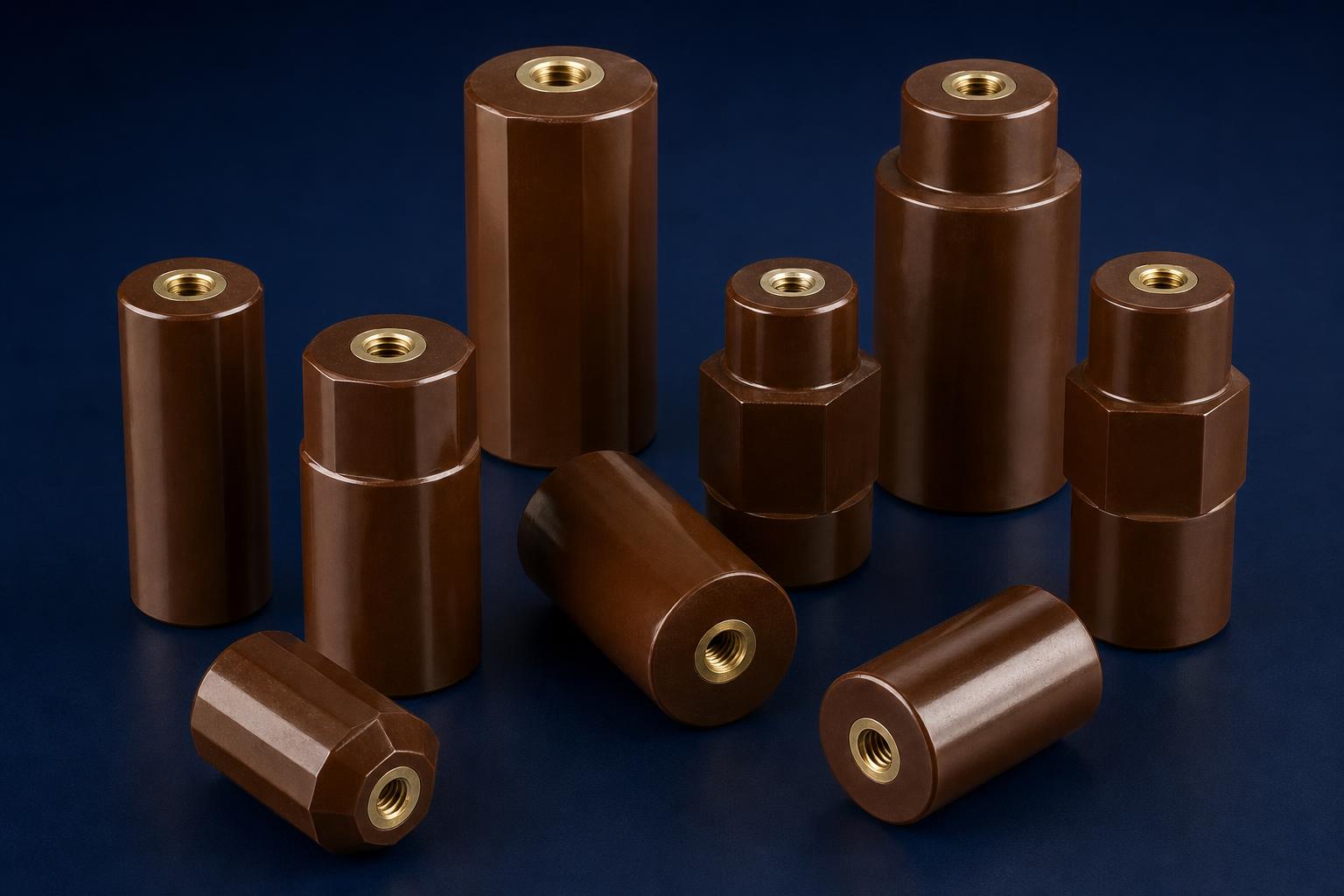
The Role of Epoxy Insulators in MV Switchgear
Every medium-voltage switchgear panel — whether it is a metal-clad indoor assembly, a ring main unit, or a gas-insulated switchgear cubicle — contains dozens of epoxy resin insulators. Their function is deceptively simple: electrically isolate live conductors from the grounded steel enclosure while mechanically supporting the weight of busbars, contacts, and cables. In reality, these insulators must simultaneously withstand:
- Power-frequency voltage: continuously at line voltage and transiently at 50 kV–185 kV peak during type tests
- Partial discharge: the inception voltage must exceed 1.5 × the phase-to-neutral voltage continuously in service
- Thermal cycling: from −25°C to +105°C in service, creating differential expansion stresses at metal-epoxy interfaces
- Mechanical load: conductor weight plus electromagnetic forces of up to 40 kA² during short-circuit events
Failures in epoxy insulators — typically from partial discharge erosion, tracking, or mechanical cracking — are a leading cause of unexpected switchgear outages. Selecting a qualified OEM supplier and specifying the correct insulator grade is therefore not a procurement detail but an engineering decision with direct impact on equipment reliability.
Manufacturing Processes: APG vs DMC
Two processes dominate epoxy insulator production for medium-voltage switchgear:
APG (Automatic Pressure Gelation)
APG is the premium process for 12–40.5 kV indoor switchgear insulators. The process involves:
- Mixing cycloaliphatic or bisphenol-A epoxy resin with a SiO₂ (quartz) filler (60–75% by weight), hardener, and accelerator under vacuum to remove all air
- Injecting the mixture under pressure (3–5 bar) into a precision steel mold preheated to 160–180°C
- Gelation and cure in 3–8 minutes; demolding; post-cure at 120°C for 4–6 hours to complete crosslinking
APG produces insulators with:
- Nearly void-free cross-section (void content typically < 0.01% by volume)
- Excellent partial discharge performance: PD < 5 pC at 1.5 × Ur / √3
- Tight dimensional tolerances: ±0.2 mm on critical dimensions
- High tracking resistance: CTI ≥ 600
DMC (Dough Moulding Compound)
DMC insulators use a glass-fibre-reinforced polyester or epoxy compound that is compression-moulded. While cheaper and faster to produce, DMC insulators have higher void content and lower partial discharge performance than APG parts. They are generally limited to:
- Low-voltage (LV) applications below 1 kV
- Secondary circuit supports inside MV panels (not primary circuit isolation)
- Applications where only mechanical strength — not high dielectric performance — is required
For 12 kV and above primary-circuit isolation, only APG insulators are appropriate.
Voltage Classes and Specifications
| Voltage Class | Rated Voltage (Ur) | Power-Freq. Withstand (1 min) | Lightning Impulse (BIL) | PD Test Voltage | Max PD Level |
|---|---|---|---|---|---|
| 12 kV | 12 kV | 28 kV r.m.s. | 75 kV peak | 10.4 kV r.m.s. | ≤ 5 pC |
| 24 kV | 24 kV | 50 kV r.m.s. | 125 kV peak | 20.8 kV r.m.s. | ≤ 5 pC |
| 40.5 kV | 40.5 kV | 85 kV r.m.s. | 185 kV peak | 35.1 kV r.m.s. | ≤ 5 pC |
The PD test voltage is calculated as 1.5 × Ur / √3 (phase-to-neutral voltage × 1.5). These values align with IEC 62271-200 Table 1 and IEC 62271-1 Annex A.
Insulator Types and Panel Applications
Standoff Insulators (Post / Support Type)
Used in busbars, cable end boxes, and isolating contact supports. Typical dimensions for 12 kV:
- Height: 80–130 mm
- Flange diameter: 60–90 mm
- Mounting holes: M8 or M10 bolts, 4-hole flange pattern
- Colour: dark brown (standard RAL 8017) or light grey
Bushing Insulators
Used where a conductor must pass through a grounded partition (e.g., cable entry plate, circuit breaker chamber wall). The bushing carries both the conductive rod and the insulating sleeve as a single assembly. APG bushings are typically produced with a threaded metallic insert at each end for mechanical connection.
Spout Insulators (Isolation Shutters)
In withdrawable-type panels, spout insulators form the stationary half of the primary-circuit isolating contacts. They guide the withdrawable truck contacts into alignment and provide the creepage distance between live and earthed parts at the interface plane. These are geometrically complex and typically require custom APG molds from the panel OEM's drawings.
Sensor-Integrated Insulators
An emerging category: standard standoff insulators with an embedded Rogowski coil or capacitive divider for metering or protection. These combine insulation and measurement functions in a single part, eliminating the need for separate current transformers on some busbar configurations.
Custom OEM Process: From Drawing to Delivery
For independent switchgear manufacturers who need custom-dimension insulators compatible with existing panel designs, the typical OEM process is:
- Drawing submission: Customer provides 2D cross-sectional drawing with all critical dimensions, thread specifications, voltage class, and quantity forecast
- Design review: Supplier reviews creepage and clearance distances against IEC 62271-1 Table 1; suggests modifications if needed
- Mold quotation: Tooling cost USD 2,000–6,000 per cavity; quoted within 5 working days
- Mold fabrication: 4–6 weeks for precision steel mold machining and polishing
- Prototype production: 3–5 sample pieces; customer tests dimensionally and electrically
- First article approval: Customer approves samples; volume production commences (MOQ typically 50–100 pieces for first run)
- Production lead time: 3–5 weeks for standard volumes; rush orders (2–3 weeks) possible for quantities ≤ 200 pieces
Material Traceability and Certifications
A qualified Chinese epoxy insulator manufacturer should maintain and provide on request:
- Resin lot traceability: Each production batch linked to the resin and hardener lot certificates; resin quality (viscosity, epoxide equivalent weight) verified by incoming inspection
- Filler particle size distribution: SiO₂ filler sieve analysis (D₅₀ typically 30–60 μm for APG resin)
- Mechanical test certificates: Bending strength ≥ 100 MPa (ISO 178), tensile strength ≥ 70 MPa
- Electrical test certificates: Partial discharge (per IEC 60270) and power-frequency withstand; test records retained ≥ 5 years
- ISO 9001:2015: Quality management certificate covering epoxy insulator production scope
How to Evaluate Chinese Epoxy Insulator Suppliers
The Chinese market has dozens of epoxy insulator producers, ranging from sophisticated APG manufacturers with laboratory facilities to small workshops using outdated compression-mould processes. Key differentiators to verify:
| Criterion | Good Supplier | Red Flag |
|---|---|---|
| Manufacturing process | APG pressure gelation, vacuum degassing before injection | Open-mould casting or DMC compression only |
| PD test capability | In-house 100% PD test on all insulators ≥ 12 kV class | Spot checks only or outsourced with long delays |
| Mold condition | Precision steel molds, clean, polished, no flash | Aluminum molds with parting-line flashing; rough surface finish |
| Third-party test reports | IEC 60168 / IEC 62155 type test from KEMA, CESI, CPRI, CQST | In-house test reports only; no independent lab |
| Documentation language | English-language datasheets, test certificates | Chinese-only documentation; no English support |
| Lead time transparency | Committed lead time with milestone schedule | Vague promises; no production schedule |
NAIJI Electric Epoxy Insulator OEM Supply
NAIJI Electric supplies APG-cast epoxy insulators as components for independent switchgear manufacturers. Our insulator production capability covers:
- Voltage classes: 12 kV, 24 kV, and 40.5 kV (12 kV BIL 75 kV through 40.5 kV BIL 185 kV)
- Types: standoff, bushing, spout, and sensor-integrated insulators
- Custom profiles: new molds from customer drawings, 6–8 week tooling lead time
- 100% PD testing on all 12 kV and above insulators before shipment
- IEC 60168 type-test reports available from independent laboratory
- English-language datasheets and test certificates provided as standard
Our insulators are used in NAIJI Electric's own switchgear panels and are available as standalone components for panel assemblers who require compatible parts. See our switchgear products: Gas-Insulated Switchgear (GSN series) | Indoor Vacuum Circuit Breakers (VN series).
For custom insulator enquiries, contact our technical team with your drawings and voltage class requirements →
Conclusion
Epoxy resin insulators are a precision-manufactured item where the difference between a compliant and a non-compliant part is invisible to the naked eye — it shows up only in partial discharge measurements or, worse, in service failures. For independent switchgear manufacturers sourcing epoxy insulators from China, the critical decision is to select a supplier who uses APG manufacturing, conducts 100% PD testing, and holds IEC type-test reports from an accredited third-party laboratory.
With the right supplier and a clear technical specification, custom-dimension epoxy insulators for VEP-pattern and other 12–40.5 kV panel designs can be procured from China at competitive cost and to the exact specifications your panel design requires.
Related reading: VEP Switchgear Components Supplier China | IEC 62271 Standard Switchgear Guide | What Is Medium Voltage?