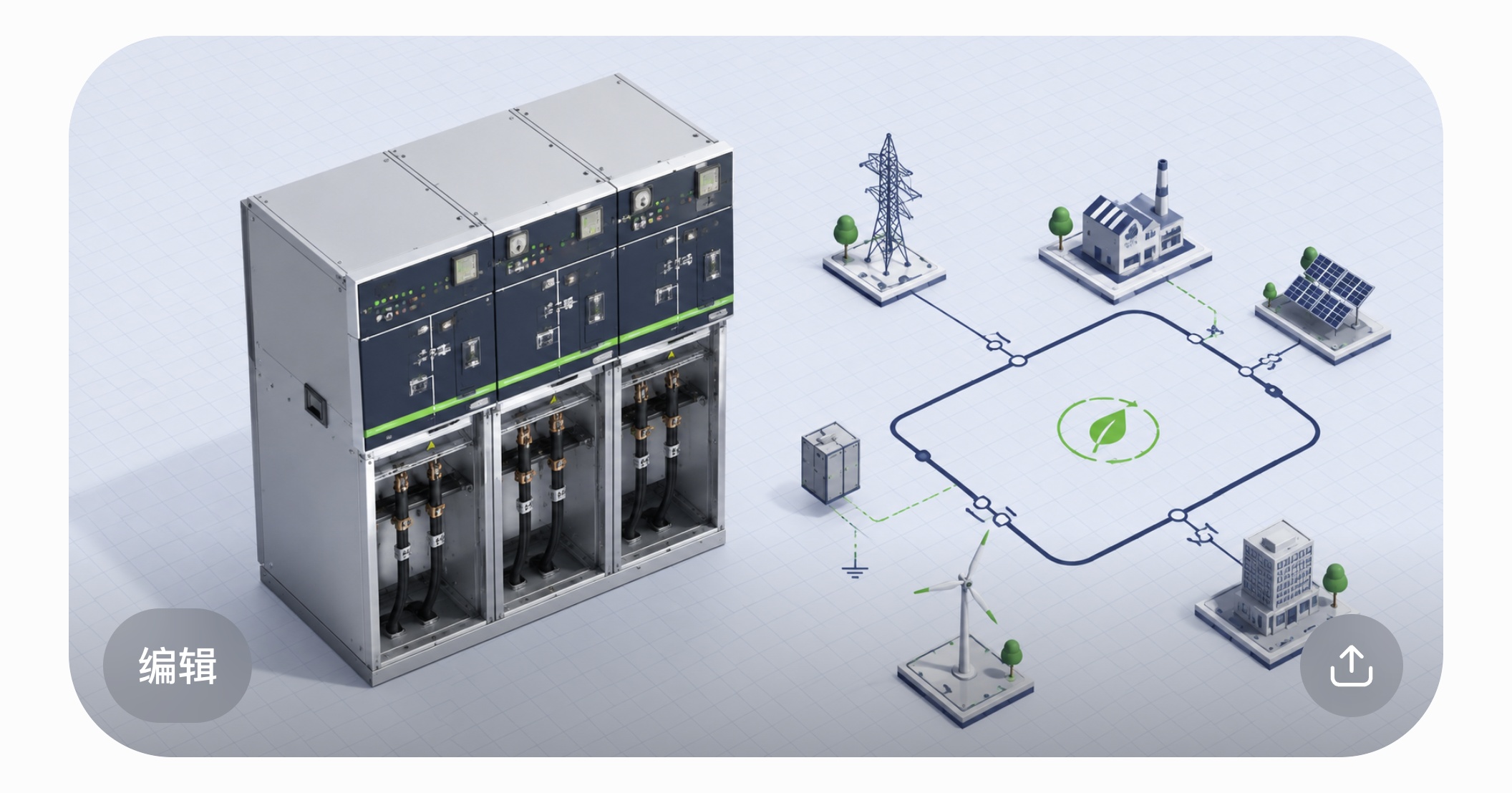
Why RMU Manufacturer Selection Matters
Ring main units are the workhorse of medium-voltage secondary distribution. Every commercial building, industrial park, residential development, and renewable energy project depends on RMUs as the interface between the primary distribution cable network and local transformer substations. Globally, hundreds of thousands of RMUs are installed every year — and the choice of manufacturer directly impacts network reliability, safety, maintenance cost, and lifecycle performance over a 25-30 year service life.
For OEM buyers, panel builders, and EPC contractors sourcing RMUs, the manufacturer selection decision is complex: there are dozens of credible suppliers globally, multiple insulation technologies (SF6, solid, hybrid), and a wide range of quality levels. This guide provides a structured framework for evaluating and selecting an RMU manufacturer, with specific criteria, technical benchmarks, and practical sourcing advice.
For a technical overview of RMU technology, see our comprehensive guide to ring main units.
Understanding RMU Types and Technologies
Before evaluating manufacturers, you need to understand the three main RMU technology families, as not all manufacturers produce all types:
1. SF6 Gas-Insulated RMUs
The traditional and still most widely installed type. All primary conductors (busbars, switch blades, connections) are enclosed in a sealed stainless steel tank filled with SF6 gas at low pressure (typically 0.03-0.05 MPa gauge). The SF6 provides both electrical insulation and arc-quenching capability for the load break switches.
- Advantages: Most compact dimensions; mature technology with decades of field experience; lowest initial cost at small production volumes
- Disadvantages: SF6 environmental concerns (GWP = 23,500); gas pressure monitoring required; end-of-life gas recovery cost; facing regulatory phase-down in EU and other regions
- Best for: Space-constrained installations; projects not subject to F-Gas regulations; cost-sensitive markets
2. Solid-Insulated (SF6-Free) RMUs
The fastest-growing segment. Busbars and switch components are insulated with cast epoxy resin or silicone rubber. Switching is performed by vacuum interrupters. No gas of any kind is used in the primary circuit.
- Advantages: Zero greenhouse gas emissions; truly maintenance-free primary circuit; immune to gas leakage; regulatory future-proof; easier end-of-life disposal
- Disadvantages: 15-25% larger dimensions than SF6 equivalents; higher material cost for epoxy casting; fewer manufacturers with proven production experience
- Best for: EU and regulated markets; green-certified buildings; clients with sustainability mandates; underground installations where gas monitoring is impractical
3. Hybrid RMUs (SF6 Insulation + Vacuum Switching)
A pragmatic middle ground. The busbar compartment uses SF6 gas for compact insulation, but the switching elements (circuit breaker, load break switch) use vacuum interrupters. This combines the space efficiency of gas insulation with the superior switching performance and endurance of vacuum technology.
- Advantages: Compact SF6-level dimensions with vacuum switching reliability; longer switching endurance than pure SF6 designs; reduced SF6 gas volume per unit
- Disadvantages: Still uses SF6 (reduced quantity but not eliminated); more complex manufacturing; slightly higher cost than pure SF6 designs
- Best for: High duty-cycle applications; installations requiring frequent switching operations; transition strategy from SF6 to fully gas-free
NAIJI Electric's XGN15-12 ring main unit uses the hybrid approach, combining SF6 busbar insulation with vacuum interrupter switching for optimal performance and reliability.
8 Critical Criteria for Evaluating RMU Manufacturers
Use this structured framework to compare manufacturers objectively:
1. Type-Test Certification Portfolio
The most important criterion. A credible RMU manufacturer must hold valid type-test reports from an accredited laboratory covering:
- IEC 62271-200: The overall switchgear assembly — including temperature rise, dielectric withstand, short-circuit withstand, and (critically) IAC internal arc classification
- IEC 62271-103: Load break switch functions — making and breaking capacity for load currents, cable charging currents, and loop switching
- IEC 62271-105: Switch-fuse combinations — coordination between the fuse and the switch
- IEC 62271-100: Circuit breaker function (if the RMU includes a VCB module)
Red flag: If a manufacturer cannot produce original type-test reports from KEMA, CESI, XIHARI, or another ILAC-accredited laboratory for the exact model and configuration you need, walk away.
2. Internal Arc Protection (IAC Rating)
Internal arc faults — though rare — are the most dangerous failure mode in medium-voltage switchgear. A qualified RMU must have an IAC classification per IEC 62271-200 that specifies:
- Accessible sides tested (F = front, L = lateral, R = rear)
- Arc current magnitude (typically 12.5 kA or 16 kA for RMUs)
- Arc duration (0.5 s or 1.0 s)
Example: IAC-AFL 16 kA 1s means the RMU is arc-resistant on front, lateral, and rear sides at 16 kA for 1 second — personnel standing within the defined safety zone will not be injured.
Never accept an RMU without IAC classification for any installation where maintenance personnel may be present.
3. Manufacturing Capability and Quality System
Evaluate the manufacturer's production maturity:
- ISO 9001 certification (minimum requirement)
- In-house testing laboratory with high-voltage test transformer, timing analyzer, gas leak detector (for SF6 types), and partial discharge measurement capability
- Dedicated RMU production line (not a general-purpose workshop that also makes unrelated products)
- Gas handling facility (for SF6 types): controlled-environment gas filling room, gas recovery equipment, moisture and purity analysis
- Clean room or controlled environment for vacuum interrupter handling (for solid-insulated and hybrid types)
- Traceability system: every RMU should have a serial number linked to component batch records, test results, and manufacturing dates
4. Product Configuration Flexibility
A mature RMU manufacturer should offer modular configurations that can be combined to match any network topology:
| Module Type | Function | Typical Designation |
|---|---|---|
| Ring switch (R) | Load break switch for ring cable connection | R, L, or V |
| Fuse switch (F) | Switch-fuse combination for transformer protection | F, T, or C |
| Circuit breaker (B) | Vacuum circuit breaker for protection and control | B, CB, or V |
| Metering (M) | Current and voltage transformer compartment | M or CT/VT |
| Direct cable (D) | Direct cable connection without switching | D or J |
Common configurations include RRF (two ring + one fuse), RRFB (two ring + fuse + breaker), RRRFB, and custom multi-panel arrangements. Ask the manufacturer: "What is the maximum number of functional units in a single RMU enclosure?" and "Can I mix and match module types freely?"
5. Voltage and Current Ratings
Verify that the manufacturer's product range covers your required specifications:
- Rated voltage: 12 kV and 24 kV are the most common; 36 kV is sometimes needed
- Rated current — busbar: 400 A or 630 A (determines how many downstream transformers can be supplied)
- Rated current — switch/breaker: 200 A, 400 A, or 630 A per functional unit
- Short-circuit withstand: 12.5 kA, 16 kA, 20 kA, or 25 kA (must match the prospective fault current at the installation point)
- Short-time current duration: 1 s or 3 s (defines thermal stress during faults)
6. Smart Grid and SCADA Integration
Modern distribution networks increasingly require RMUs with remote monitoring and control capabilities:
- Motorized operation: Motor-driven switches and circuit breakers for remote open/close commands
- Sensors: Current transformers (CTs), voltage indicators or voltage transformers (VTs), temperature sensors, partial discharge sensors
- Communication protocols: IEC 61850 (international standard for substation communication), DNP3.0, Modbus, IEC 60870-5-104
- Local intelligence: Integrated fault passage indicators (FPIs), short-circuit/earth-fault detection, overcurrent protection relay
- Remote terminal unit (RTU): Built-in or modular RTU for SCADA/DMS integration
Ask the manufacturer about their smart RMU capabilities and request reference projects where their SCADA-integrated RMUs have been deployed.
7. Export Track Record and International References
For international procurement, verify:
- Export volume: How many RMUs does the manufacturer export annually, and to which countries?
- Utility references: Can they provide reference letters or project lists from international utilities or EPC contractors?
- OEM customers: Do they currently supply RMUs on a private-label basis to international switchgear brands?
- CE marking: Do they hold CE marking for European market access?
- After-sales support: Do they have English-speaking engineers, international warranty service capability, and spare parts logistics?
8. Pricing Transparency and Total Cost
Evaluate pricing holistically:
- Unit price: FOB or CIF pricing per RMU configuration
- Volume pricing: Discounts for annual framework agreements or container-load orders
- Customization surcharges: Cost for non-standard configurations, special finishes, or custom branding
- Spare parts pricing: Cost and availability of replacement components (vacuum interrupters, fuse links, motor operators, gaskets)
- Warranty terms: Standard warranty period (12-24 months typical); extended warranty options
- Testing and inspection costs: Charges for witnessed routine tests, special tests, or factory acceptance testing
How to Conduct an RMU Factory Audit
If you are placing orders exceeding $50,000 or establishing a long-term supply relationship, a factory audit is essential. Here is a structured audit checklist:
Production Facility
- Dedicated RMU assembly area (not mixed with unrelated products)
- Clean, organized workspace with proper ESD protection for vacuum interrupter handling
- Gas filling room with humidity and temperature control (SF6 types)
- Epoxy casting or molding facility (solid-insulated types)
- Sheet metal fabrication capability (in-house or verified subcontractor)
- Painting/powder coating line with quality standards (corrosion resistance is critical for outdoor/underground RMUs)
Testing Laboratory
- Power-frequency withstand test transformer (at least 50 kV capability for 12 kV class)
- Mechanical operation test bench with cycle counter
- Timing analyzer for circuit breaker/switch operation times
- Gas leak detection equipment (SF6 types) — helium mass spectrometer or SF6 sniffer
- Partial discharge measurement system
- Current injection equipment for protection relay testing
Quality Management
- Incoming material inspection records (component suppliers, batch traceability)
- In-process inspection checkpoints (documented and enforced)
- 100% routine test records for shipped units
- Non-conformance handling process (reject rates, root cause analysis, corrective actions)
- Customer complaint tracking and resolution records
Step-by-Step RMU Sourcing Process
Follow this proven process for successful RMU procurement:
- Define your technical specification: Voltage, current, breaking capacity, number and type of functional units, insulation type preference, smart grid requirements, environmental conditions (indoor/outdoor, climate zone, altitude)
- Shortlist 3-5 manufacturers: Based on the evaluation criteria above, narrow your search to 3-5 qualified manufacturers
- Request formal quotations: Send identical technical specifications to all shortlisted manufacturers. Request pricing, delivery time, type-test report references, and reference customer lists
- Evaluate quotations technically: Compare not just price but compliance with your specification, type-test coverage, and deviation lists
- Factory audit or third-party inspection: Visit the top 1-2 candidates or commission a third-party audit
- Sample order: Order 2-5 units as a trial. Perform incoming inspection and, if possible, independent testing
- Negotiate framework agreement: Based on sample results, negotiate annual pricing, delivery schedules, quality guarantees, and warranty terms
- Ongoing quality monitoring: Establish a routine quality monitoring program — periodic factory inspections, witnessed routine tests on selected batches, and field performance tracking
5 Common Mistakes in RMU Procurement
Avoid these costly errors that we see international buyers make repeatedly:
1. Choosing on Price Alone
The cheapest RMU is almost never the best value. A $500 savings on purchase price can easily become a $5,000-$50,000 loss from premature failure, gas leakage, or non-compliance discovered during commissioning. Always evaluate lifecycle cost, not just purchase price.
2. Not Verifying Type-Test Reports
Some manufacturers present type-test reports for a different model, a different voltage class, or an older version of the product. Always verify that the type-test report covers the exact product configuration, rated voltage, rated current, and breaking capacity you are purchasing.
3. Ignoring Internal Arc Protection
An RMU without IAC classification is a safety risk. Even if local regulations don't explicitly require IAC, responsible engineering practice demands it for any installation where maintenance personnel may be present. Never accept "IAC not tested" for indoor or accessible outdoor RMUs.
4. Overlooking Smart Grid Readiness
Even if your current network doesn't use SCADA, choose RMUs that can be upgraded with motorized operators, CTs/VTs, and communication modules. Retrofitting these capabilities later is 3-5x more expensive than specifying them at procurement.
5. Neglecting After-Sales Support
An RMU will be in service for 25-30 years. If the manufacturer cannot provide spare parts, technical support, and warranty service internationally, you will face problems. Verify after-sales capability before placing orders, not after a failure occurs.
NAIJI Electric: Your RMU Manufacturing Partner
NAIJI Electric manufactures a comprehensive range of ring main units designed for international OEM buyers and distribution network operators:
- XGN15-12 SF6 Ring Main Unit: 12 kV, up to 630 A, 20 kA breaking capacity. Hybrid design with SF6 busbar insulation and vacuum interrupter switching. Available in R, F, B, M, and D module configurations. IAC type-tested. Compact footprint suitable for space-constrained installations.
- Complete switchgear ecosystem: Pair RMUs with NAIJI's indoor vacuum circuit breakers, metal-enclosed switchgear, and gas-insulated switchgear for complete substation solutions from a single manufacturer
- OEM/ODM capability: Custom branding, modified configurations, and private-label production. We currently supply RMUs to distributors and panel builders in 20+ countries.
- Full IEC compliance: Type-tested per IEC 62271-200, IEC 62271-103, and IEC 62271-105. CE marking available for European market.
- Smart grid ready: Motorized operation, integrated CTs/VTs, IEC 61850 communication, and fault passage indication are available as factory-installed options
Our engineering team can help you specify the optimal RMU configuration for your network topology, environmental conditions, and budget. Whether you need a standard 3-way RMU for a commercial building or a custom multi-panel configuration for an industrial substation, NAIJI Electric has the product range and manufacturing flexibility to deliver.
Ready to discuss your RMU requirements? Contact NAIJI Electric for a technical consultation, factory tour invitation, and competitive quotation. Visit our factory page to learn more about our production capabilities and testing laboratory.