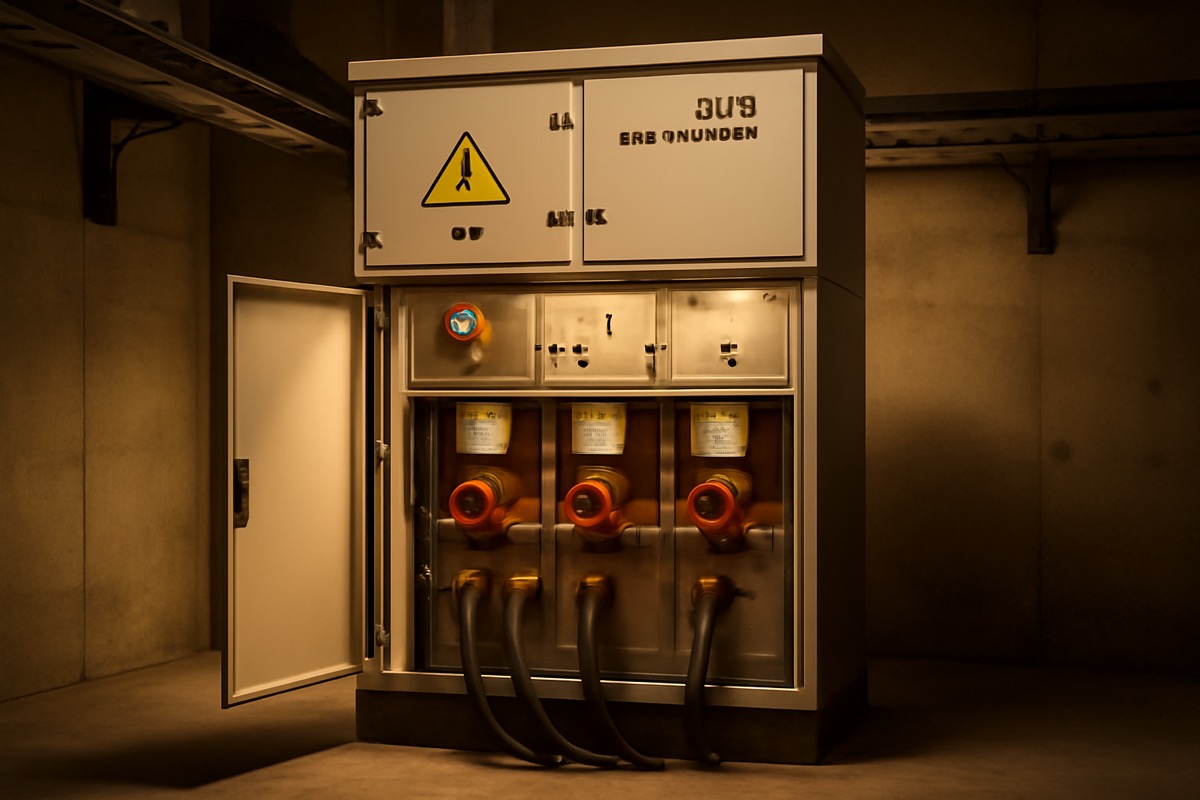
What Is a Ring Main Unit? Definition and Role in Power Distribution
A ring main unit (RMU) is a compact, factory-sealed switchgear assembly used in medium-voltage (MV) secondary distribution networks, typically rated at 12 kV or 24 kV. It is the backbone of modern urban underground cable distribution systems, enabling loop (ring) network configurations that supply power to each customer from two directions simultaneously.
The key advantage of a ring network over a radial network is supply continuity: if a fault occurs on one section of the ring, power can still reach every customer through the alternate path. The RMU sits at each connection point — transformer substations, commercial buildings, industrial parks — and provides the switching and protection functions needed to manage the ring.
RMUs are widely used in:
- Urban underground cable distribution networks
- Commercial high-rise buildings and shopping centers
- Industrial parks and factory power supply
- Renewable energy grid connection substations
- Hospital, data center, and critical infrastructure power supply
How Does a Ring Main Unit Work?
An RMU typically contains two or more switching modules assembled into a single enclosure. The most common configuration is two incoming (ring) modules connected to the cable ring, plus one or more outgoing (feeder) modules that supply power to local transformers or loads.
Here is how a typical 2L+1F ring main unit operates in a cable ring network:
- Normal operation: Both load break switch (L) modules are closed, completing the ring circuit. Power flows through the RMU from both directions. The fuse-switch (F) module feeds the local transformer.
- Scheduled maintenance: An operator opens one L module to isolate a cable section for maintenance. Power continues to flow through the other L module — no outage for the customer.
- Transformer fault: If the local transformer develops a short circuit, the HV HRC fuse in the F module blows, disconnecting the faulty transformer. The ring circuit remains intact; other customers are unaffected.
- Cable fault: If a cable section faults, the protection relay at the source substation trips the feeder breaker. Operators locate the fault, open the two L modules on either side of the faulty section to isolate it, and restore power to the healthy sections from both ends.
This architecture provides N-1 redundancy — any single fault can be isolated without losing supply to other customers — which is why ring main units are the global standard for urban medium-voltage distribution.
Ring Network vs Radial Network: Why Rings Win
In a radial network, each customer is supplied from a single direction. If a cable or transformer fails, every customer downstream of the fault loses power until the fault is repaired — which can take hours or even days for underground cable faults. In a ring network, power reaches each customer from two directions through two parallel paths. When a fault occurs, operators isolate only the faulted section, and all other customers continue to receive power through the alternate path. The ring main unit at each node makes this switching possible.
The economic case for ring networks is clear: while the initial cable and switchgear investment is higher (roughly 30-50% more than a radial design), the reduction in customer outage costs far outweighs the capital difference, especially for commercial and industrial loads where unplanned outages can cost $10,000-$100,000 per hour. This is why virtually every urban distribution network built in the last 30 years uses a ring topology with RMUs.
Types of Ring Main Units
1. SF6 Gas-Insulated RMU
The most widely used type worldwide. All switching components (load break switches, vacuum interrupters, earthing switches) are enclosed in a sealed stainless-steel tank filled with SF6 gas at low pressure (typically 0.03-0.05 MPa gauge). SF6 provides both electrical insulation and arc quenching.
Advantages:
- Very compact footprint — 40-60% smaller than air-insulated designs
- Maintenance-free sealed gas compartment (25+ year service life)
- High dielectric strength — withstands 75 kV lightning impulse
- IP67 rated gas tank — suitable for harsh environments (flooding, dust, high humidity)
Typical application: Urban underground networks, basement substations, commercial buildings.
2. Air-Insulated RMU (AIRMU)
Uses air as the insulating medium, with vacuum interrupters for arc quenching. Larger than SF6 designs but eliminates greenhouse gas concerns entirely.
Advantages:
- Zero greenhouse gas — fully compliant with EU F-Gas Regulation
- No gas handling equipment needed for installation or decommissioning
- Lower environmental lifecycle impact
Typical application: Regions with strict environmental regulations, green building projects.
3. Solid-Insulated (Vacuum) RMU
Uses epoxy resin or silicone rubber as solid insulation around vacuum interrupters. No gas of any kind is used. This is an emerging technology gaining market share in regions phasing out SF6.
Advantages:
- Completely gas-free — no SF6, no air pressure management
- Compact design approaching SF6 dimensions
- Long service life with minimal maintenance
Typical application: New installations in Europe and other regions with F-Gas restrictions.
Choosing Between RMU Types
For most applications worldwide, SF6 gas-insulated RMUs remain the standard choice due to their proven reliability, compact size, and 25+ year maintenance-free track record. Air-insulated and solid-insulated designs are gaining traction in Europe and other regions with strict F-Gas regulations, but their larger footprint and higher cost currently limit their adoption in developing markets. When specifying an RMU for a project in Asia, Africa, or Latin America, SF6 gas-insulated units are typically the most practical and cost-effective option.
RMU Module Types: V, L, F, and C Explained
Ring main units are configured from standardized functional modules, each providing a specific switching or protection function. Understanding these modules is essential for specifying the right RMU for your project:
| Module | Full Name | Function | Breaking Capability | Typical Use |
|---|---|---|---|---|
| V | Vacuum Circuit Breaker | Switches and protects against load and fault currents | Up to 25 kA at 12 kV | Transformer feeders requiring automatic protection |
| L | Load Break Switch | Switches load currents; cannot break fault currents | 630 A load current; makes but does not break fault current | Ring cable incoming/outgoing connections |
| F | Fuse-Switch Combination | Switches load currents + fuse protects against short circuits | Fuse breaks fault current up to 50 kA | Transformer feeders up to 630 kVA |
| C | Cable Connection / Metering | Cable termination, metering CTs, and VTs | No switching capability | Metering cubicles, cable junction points |
Common RMU Configurations
- 2L + 1F — Two load break switch modules (ring in/out) + one fuse-switch module (transformer feeder). The most common configuration for distribution transformer substations.
- 2V + 1F — Two vacuum breaker modules + one fuse-switch module. For substations requiring automatic fault isolation on the ring cables.
- 3L + 1F — Three load break switch modules + one fuse-switch module. For multi-cable junction points.
- L + F — Simplified two-module unit for radial feeders or small loads.
- V + F — One vacuum breaker + one fuse-switch module. For spur connections with protection requirements.
Where Are Ring Main Units Used?
1. Urban Underground Cable Networks
This is the primary application for RMUs. In dense urban areas, overhead lines are replaced with underground cables for safety and aesthetics. RMUs are installed at each junction point — typically in compact ground-level or underground kiosks — to form a ring network. A medium-sized city may have hundreds to thousands of RMUs in service.
2. Commercial Buildings and Shopping Centers
High-rise office buildings, shopping malls, and hotel complexes typically have a dedicated basement substation with an RMU as the MV switching device. The compact footprint of an SF6 RMU (typically 1.5-2 m wide for a 2L+1F unit) is ideal for space-constrained basements.
3. Industrial Parks and Factory Power Supply
Industrial parks with multiple factories connected to a shared MV cable ring use RMUs at each factory's intake substation. This provides redundant power supply and allows individual factories to be isolated for maintenance without affecting others.
4. Renewable Energy Grid Connections
Solar farms and wind farms typically connect to the distribution grid at 10-35 kV. An RMU at the point of common coupling (PCC) provides the necessary switching and protection. The sealed, maintenance-free design is particularly suitable for remote renewable energy installations.
5. Critical Infrastructure
Hospitals, data centers, airports, and water treatment plants require the highest levels of power supply reliability. Ring main units with motorized operation and remote control enable fast fault isolation and supply restoration — critical when downtime costs are measured in thousands of dollars per minute.
RMU Installation and Commissioning Best Practices
Proper installation is critical for ensuring the long service life and reliable operation of a ring main unit. Key considerations include:
- Foundation and mounting: RMUs must be installed on a level, load-bearing foundation (typically reinforced concrete) that supports the unit's weight (300-800 kg depending on configuration). The foundation should be elevated 100-200 mm above the surrounding floor level to prevent water ingress.
- Cable termination: Medium-voltage cable terminations must be made according to the cable manufacturer's instructions, using heat-shrink or cold-shrink termination kits rated for the RMU's voltage class. Incorrect termination is the most common cause of RMU failures in the field.
- Earthing: The RMU enclosure must be connected to the site earthing system via a copper earth conductor of at least 70 mm² cross-section. All cable screens and armor must also be earth-bonded at the RMU.
- Ventilation: While the sealed gas compartment does not require ventilation, the cable compartment should have adequate ventilation to prevent condensation, especially in tropical climates.
- Commissioning tests: Before energizing, perform insulation resistance measurement (minimum 1 GΩ at 5 kV DC), SF6 gas pressure verification, mechanical operation test (5 close-open cycles on each switch), and earth continuity check.
How to Select the Right Ring Main Unit
When specifying an RMU for your project, consider these key parameters:
- Rated voltage: Match to your distribution network voltage (12 kV, 24 kV, or 36 kV).
- Rated current: The bus (ring) current and branch (feeder) current. Typical values: 630 A bus, 200 A branch.
- Short-circuit rating: Must withstand the prospective fault current at the installation point. Common values: 20 kA or 25 kA for 4 seconds.
- Module configuration: Select V, L, F, or C modules based on the required switching and protection functions.
- Insulation type: SF6 (most compact), air-insulated (no SF6), or solid-insulated (no gas at all).
- Installation environment: Indoor (IP3X minimum), outdoor (IP43+), or underground (IP67 for the gas tank).
- Cable entry: Front, rear, or bottom cable entry to match your substation layout.
- Motorized operation: Required if remote switching or SCADA integration is needed.
- Standards compliance: IEC 62271-200, GB 3906, or regional standards.
Ring Main Unit vs Conventional Switchgear: Key Differences
Engineers often ask when to use a ring main unit instead of conventional metal-clad or metal-enclosed switchgear panels. The table below clarifies the differences:
| Parameter | Ring Main Unit (RMU) | Conventional Switchgear Panel |
|---|---|---|
| Typical Application | Secondary distribution (cable loops) | Primary distribution (substations) |
| Insulation | SF6, nitrogen, or solid (sealed) | Air-insulated (open compartments) |
| Footprint per Module | 400-800 mm width | 800-1,200 mm width |
| Maintenance | Virtually maintenance-free (sealed gas) | Regular inspection and cleaning required |
| Current Rating | Up to 630 A bus, 200 A branch | Up to 5,000 A bus, 3,150 A branch |
| Breaking Capacity | 20-25 kA (with V module) | 25-50 kA |
| Cost per Bay | $3,000-$8,000 | $8,000-$25,000 |
| IP Rating | IP67 (gas tank) | IP31-IP41 typically |
Rule of thumb: Use an RMU for cable ring network nodes where current is below 630 A and space is limited. Use conventional switchgear for main substations, motor control, or applications requiring high continuous current and full protection relay suites. For detailed engineering specifications, see our RMU design and engineering selection guide.
Ring Main Unit Standards and Testing
Ring main units must comply with the same fundamental standards as all medium voltage switchgear, plus additional requirements specific to compact gas-insulated designs:
- IEC 62271-200: Metal-enclosed switchgear — defines construction requirements, compartment classification (LSC), and internal arc testing (IAC)
- IEC 62271-105: Switch-fuse combinations — specific type tests for the F (fuse-switch) module used in most RMU configurations
- IEC 62271-103: Load break switches — defines switching duties for the L module including loop-switching, cable-charging current switching, and earth fault current switching
- IEC 62271-203: Applied to gas-insulated RMU designs — additional requirements for gas tightness, partial discharge, and gas monitoring
- IEC 62271-202: High-voltage/low-voltage prefabricated substations — relevant when the RMU is integrated into a compact substation with transformer and LV panel
When evaluating RMU manufacturers, always request valid type-test reports from accredited laboratories (KEMA, CESI, XIHARI). For a complete overview of switchgear testing procedures and what to look for in test reports, see our testing guide.
Ring Main Units in Smart Grid and Distribution Automation
Modern ring main units are evolving beyond simple switching devices into intelligent network nodes. Smart RMU capabilities include:
- Motorized switching: Remote operation of load break switches and circuit breakers via SCADA or distribution management system (DMS)
- Fault passage indicators (FPI): Sensors detect fault current direction, enabling automated fault location in ring networks — reducing fault-finding time from hours to minutes
- IEC 61850 communication: GOOSE messaging between RMUs enables peer-to-peer automatic fault isolation without a central controller
- Environmental monitoring: Integrated sensors for SF6/nitrogen pressure, temperature, humidity, and partial discharge — providing real-time asset health data
- Self-healing networks: When combined with fault passage indicators and motorized switches, a ring of smart RMUs can automatically detect, isolate, and restore power around a fault within 60 seconds — matching the performance of traditional substation-based schemes at a fraction of the cost
These capabilities align with global smart grid initiatives and are increasingly required in tender specifications for urban distribution network projects. For protection relay coordination in automated networks, see our protection relay selection guide.
NAIJI Electric XGN15-12 Ring Main Unit
The NAIJI Electric XGN15-12 is a fully gas-insulated compact ring main unit designed for 10-12 kV distribution networks. Key specifications:
| Parameter | Value |
|---|---|
| Rated Voltage | 12 kV |
| Rated Current (Bus) | 630 A |
| Rated Current (Branch) | 200 A |
| Rated Short-Circuit Making Current | 50 kA (peak) |
| Rated Short-Time Withstand Current | 20 kA / 4 s |
| Power Frequency Withstand Voltage | 42 kV |
| Lightning Impulse Withstand Voltage | 75 kV |
| Gas Pressure | 0.03 MPa at 20 °C |
| Protection Rating | IP67 (gas tank) / IP3X (cable compartment) |
| Configurations Available | 2L+1F / 2V+1F / V+F / L+F |
| Standards | IEC 62271-200, GB 3906 |
The XGN15-12 features a sealed stainless-steel gas tank with a design life of 30 years, front-accessible cable compartments for easy installation, and optional motorized operation for remote control applications. It is widely deployed in urban underground cable networks, commercial building substations, industrial parks, and renewable energy connection points across 20+ countries.
Related guides: Vacuum circuit breaker vs SF6 comparison | SF6-free switchgear alternatives | Indoor vacuum circuit breaker guide
Contact our engineering team for detailed technical data sheets, dimensional drawings, and project quotations.