
Quick Answer: Which Ring Main Unit Type Should You Choose?
For new distribution network projects in 2026 and beyond, solid-insulated (SIS) RMUs are the recommended default choice at 12-24 kV. They offer zero greenhouse gas risk, true maintenance-free operation, and 30-year design life — all while matching SF6 RMU performance. Choose SF6 RMUs only when dimensional constraints demand the absolute smallest footprint, or when retrofitting existing SF6 installations with identical dimensions. Choose air-insulated RMUs for budget-sensitive projects with adequate space. Below, we compare all three types across 12 engineering dimensions with pricing, specifications, and application guidance.
What Is a Ring Main Unit and Why Does It Matter?

A ring main unit (RMU) is a compact, factory-assembled, medium-voltage switchgear assembly designed for secondary distribution cable networks. RMUs are the backbone of urban power distribution — every time you see a ground-level transformer substation in a city, industrial park, commercial complex, or residential development, there is almost certainly an RMU inside providing the switching and protection functions.
The name "ring main" comes from the network topology: underground cables form a closed loop (ring), with power available from two directions. When a fault occurs on one cable section, the RMU isolates it while maintaining supply from the other direction. This ring topology delivers 99.97%+ supply reliability — the standard expected by modern urban distribution networks.
RMUs matter because they represent the largest single equipment category in medium-voltage distribution. An estimated 2-3 million RMUs are installed globally each year, driven by urbanization, underground cable network expansion, and the renewable energy buildout. Understanding RMU types, voltage ratings, and selection criteria is essential for utility engineers, EPC contractors, and electrical consultants working in power distribution.
Three RMU Insulation Types: SF6 vs Solid Insulated vs Air
The insulation medium is the most fundamental differentiator between RMU types. It determines the unit's physical size, maintenance requirements, environmental impact, and cost. Here is a systematic comparison:
SF6 Gas-Insulated RMU
SF6 (sulfur hexafluoride) RMUs have been the industry standard since the 1980s. SF6 gas at 0.03-0.15 MPa gauge pressure provides both electrical insulation and arc-quenching capability in a sealed compartment. This allows the most compact designs — a 3-way SF6 RMU can fit in a footprint as small as 1,000 mm x 600 mm x 1,300 mm.
However, SF6 is the most potent greenhouse gas known — with a GWP of 23,500 and an atmospheric lifetime of 3,200 years. The EU F-Gas Regulation (2024/573) mandates phase-down of SF6 in new medium-voltage switchgear below 24 kV. By January 2026, SF6 use in new MV switchgear is already restricted in the EU. Major manufacturers (ABB, Siemens, Schneider, Eaton) have launched SF6-free alternatives.
SF6 RMU annual gas leakage rate per IEC 62271-200: <0.5% per year for sealed-for-life units, <1% per year for sealed-pressure systems.
Solid-Insulated RMU (SIS)
Solid-insulated RMUs use cast epoxy resin to encapsulate the live conductors, busbars, and connection points. Arc quenching is performed by vacuum interrupters. No gas of any kind is used — making SIS RMUs completely gas-free and immune to altitude derating, gas leakage, or environmental contamination.
SIS technology has matured rapidly since 2010. Today, solid-insulated RMUs are available at 12 kV and 24 kV with rated currents up to 630 A and breaking capacities up to 25 kA — matching SF6 RMU performance in the vast majority of applications. The footprint penalty versus SF6 is now only 10-20%, down from 30-40% a decade ago.
Key advantage: SIS RMUs are truly maintenance-free. There is no gas to check, no pressure to monitor, no decomposition products to manage. This reduces total cost of ownership by 15-25% over a 30-year service life compared to SF6 units.
Air-Insulated RMU
Air-insulated RMUs use atmospheric air as the primary insulation medium. Switching is typically performed by vacuum interrupters in the circuit breaker/switch modules. The design is the simplest and most transparent — all components are visible and accessible for inspection.
The trade-off is size: an air-insulated RMU requires 40-60% more floor space than an equivalent SF6 unit. However, air-insulated designs have gained renewed interest since 2024 as utilities seek straightforward SF6 alternatives without the higher cost of solid insulation.
ABB's SafeRing Air and SafePlus Air are prominent examples of the air-insulated approach, using dry air (GWP = 0) as the insulation medium.
RMU Type Comparison: 12 Engineering Dimensions
| Parameter | SF6 Gas-Insulated | Solid Insulated (SIS) | Air-Insulated |
|---|---|---|---|
| Insulation medium | SF6 gas (0.03-0.15 MPa) | Cast epoxy resin | Atmospheric air |
| Arc quenching | SF6 gas | Vacuum interrupter | Vacuum interrupter |
| Footprint (3-way RRT) | Smallest (1.0 x 0.6 m) | 10-20% larger | 40-60% larger |
| Weight (3-way RRT) | 200-350 kg | 250-400 kg | 350-500 kg |
| Max voltage class | Up to 40.5 kV | Up to 24 kV (expanding to 36 kV) | Up to 36 kV |
| Rated current (LBS) | 200-630 A | 200-630 A | 200-630 A |
| Breaking capacity (VCB) | Up to 25 kA | Up to 25 kA | Up to 25 kA |
| Design life | 30 years | 30 years | 25-30 years |
| Maintenance | Annual gas pressure check | None (truly maintenance-free) | Periodic cleaning |
| Environmental impact (GWP) | 23,500 (per kg SF6) | 0 | 0 |
| Altitude derating | Minimal (sealed gas) | None (solid insulation) | Significant above 1,000 m |
| Cost (12 kV, 3-way) | $2,000-$4,000 | $3,000-$6,000 | $1,800-$3,500 |
RMU Voltage Ratings: 12 kV, 24 kV, and 36 kV
Ring main units are manufactured for specific voltage classes per IEC 62271-200. The voltage rating must be equal to or greater than the system voltage. Here is what each class covers:
| Rated Voltage | System Voltage | BIL (kV) | Primary Application | Global Market Share |
|---|---|---|---|---|
| 12 kV | 10-11 kV | 75 | Urban distribution, industrial parks, commercial zones | ~70% |
| 24 kV | 20-22 kV | 125 | European distribution networks, new urban development | ~20% |
| 36 kV | 33-35 kV | 170 | Wind farm collectors, sub-transmission, large industrial | ~10% |
12 kV dominates because the majority of the world's distribution networks operate at 10-11 kV (China, Southeast Asia, Middle East, Africa, South America). Europe is transitioning many networks from 10 kV to 20 kV, driving demand for 24 kV RMUs. The 36 kV class serves a niche but growing market in renewable energy collector systems where wind turbines connect at 33 kV.
NAIJI Electric manufactures RMUs in both 12 kV and 24 kV classes. Our XGN15-12 covers 12 kV applications with rated current up to 630 A and 20 kA breaking capacity.
RMU Switching Modules: Load Break Switch, Fuse, and VCB
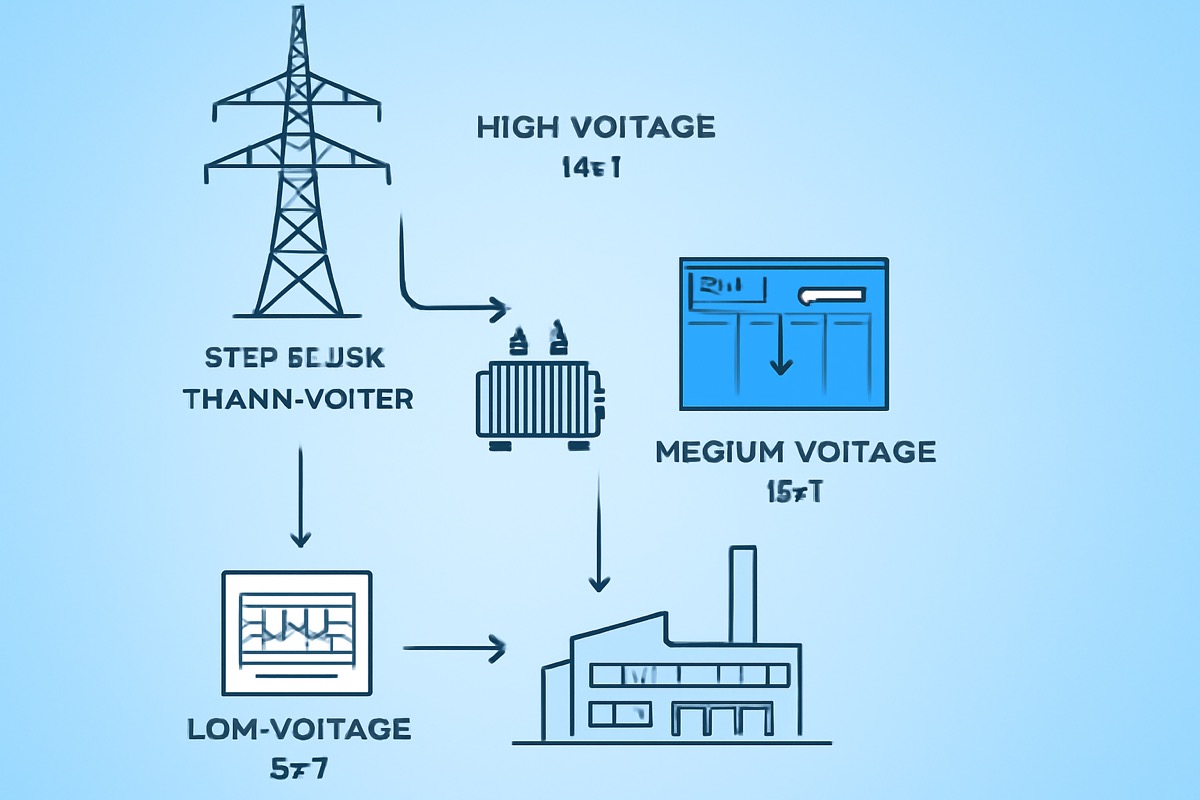
An RMU consists of modular switching units assembled in different combinations. Understanding each module type is essential for specifying the right RMU configuration:
Load Break Switch Module (L or R)
The load break switch (LBS) is a three-position device: closed / open / earthed. It can make and break load currents (up to 630 A) but cannot interrupt short-circuit currents. LBS modules form the ring connections — the cable-in / cable-out functions that maintain the ring network continuity.
Key specifications per IEC 62271-103:
- Rated current: 200 A, 400 A, or 630 A
- Short-time withstand current: 16 kA or 20 kA for 3 seconds
- Making capacity: 2.5x peak short-circuit current (40-50 kA peak)
- Mechanical endurance: 1,000-5,000 operations
Fuse-Switch Combination Module (F)
The fuse-switch combination (also called a fuse switch or switch-fuse module) pairs a load break switch with three current-limiting HV fuses. This combination protects distribution transformers up to 630 kVA at 12 kV (or up to 1,000 kVA at 24 kV). When a fuse operates due to a downstream fault, the striker pin mechanism forces the switch to open all three phases simultaneously — preventing single-phasing of the transformer.
Fuse-switch modules are the most cost-effective protection solution for transformer feeders. They cost 40-60% less than a full vacuum circuit breaker module while providing adequate protection for the vast majority of distribution transformers.
Vacuum Circuit Breaker Module (V)
The VCB module provides full fault-making and fault-breaking capability up to 20-25 kA. It is used for:
- Transformer feeders above 630 kVA (where fuses are not adequate)
- Important loads requiring automatic reclosing
- Generator connections
- Renewable energy interconnection points requiring protection relay coordination
VCB modules add $1,500-$3,000 to the RMU cost versus a fuse-switch module but provide programmable protection, remote operation, and auto-reclosing capability.
Common RMU Configurations
| Configuration | Modules | Application | Typical Price (12 kV, FOB) |
|---|---|---|---|
| 2L + 1F (3-way) | 2 load break switches + 1 fuse-switch | Standard secondary substation, single transformer ≤630 kVA | $2,000-$4,000 |
| 2L + 2F (4-way) | 2 load break switches + 2 fuse-switches | Dual-transformer substation | $3,000-$5,500 |
| 2L + 1V (3-way) | 2 load break switches + 1 VCB | Important loads, renewable energy, auto-reclosing | $3,500-$6,000 |
| 3L + 1F (4-way) | 3 load break switches + 1 fuse-switch | Ring junction with one transformer | $3,000-$5,000 |
| 2L (2-way) | 2 load break switches only | Cable junction point (no transformer) | $1,500-$2,500 |
Extensible vs Non-Extensible RMU Designs
This is one of the most important design decisions when specifying RMUs, and it is often overlooked:
Non-Extensible (Sealed Unit) RMU
All functional modules share a single sealed gas or insulation compartment. The unit is factory-assembled as one piece and cannot be modified in the field.
- Advantages: Most compact footprint, lowest cost per module, simplest installation, lowest gas leakage risk (one sealed compartment)
- Disadvantages: Cannot be expanded — if the network grows, you must replace the entire RMU
- Best for: Established networks with fixed topology, budget-constrained projects
Extensible (Modular) RMU
Each functional module is a self-contained unit with its own insulation system. Modules are bolted together on-site using standardized busbar connections.
- Advantages: Can add modules as the network grows, can replace individual modules without disturbing the rest, flexible configuration
- Disadvantages: 15-30% higher cost per module, more busbar joints (potential reliability concern), larger footprint
- Best for: New development areas, networks expected to expand, utilities that want standardized modular inventory
Application Scenarios for Ring Main Units
Urban Distribution Networks
The primary application. Underground cable networks in cities use RMUs at every secondary substation — typically one RMU every 300-500 meters along the cable route. A city of 1 million people may have 2,000-5,000 RMUs in its distribution network. Space is at a premium, making compact SF6 or SIS designs preferred.
Industrial Parks & Commercial Zones
Industrial parks use ring networks to ensure reliable power supply to factories, warehouses, and data centers. RMU configurations in industrial parks tend to have more VCB modules (versus fuse-switch modules) because industrial loads are larger and require more sophisticated protection.
Renewable Energy (Solar Farms & Wind Farms)
Each wind turbine in a wind farm connects to the collector network via a 33 kV or 12 kV RMU. A 100 MW wind farm with 50 turbines needs approximately 50-55 RMUs. Solar farms use RMUs at inverter transformer connections and at the point of common coupling (PCC) with the grid. The modular (extensible) RMU design is preferred for renewable energy because projects often expand in phases.
Compact Substations
A compact (prefabricated) substation integrates an RMU, distribution transformer, and LV panel in a single weatherproof enclosure. This is the standard solution for new residential developments, shopping centers, and industrial facilities. NAIJI Electric offers complete compact substation packages — see our guide: Compact Substation Design Guide.
How to Select the Right RMU: 7 Decision Factors
1. Insulation Type
Start with the insulation question. If you are in the EU or a region with F-gas regulations, SIS or air-insulated is mandatory for new installations below 24 kV. If footprint is the #1 constraint, SF6 may still be the only option. Otherwise, SIS offers the best balance of performance, cost, and environmental compliance.
2. Voltage Class
Match to your system voltage with margin. For a 10 kV system, use 12 kV rated RMU. For a 20 kV system, use 24 kV rated. Never use an RMU below your system's rated voltage.
3. Rated Current
Determine the maximum continuous load current per feeder. Standard ratings: 200 A, 400 A, 630 A. For urban distribution, 400 A covers most applications. For industrial feeders or renewable energy, 630 A may be needed.
4. Protection Requirement
Fuse-switch modules for transformers ≤630 kVA (cost-effective). VCB modules for transformers >630 kVA, important loads, auto-reclosing, or relay-coordinated protection schemes.
5. Extensibility
Choose extensible for new development areas. Choose non-extensible for established networks and budget-constrained projects.
6. Environmental Conditions
Altitude above 1,000 m: SIS preferred (no derating). Coastal/high humidity: sealed SF6 or SIS (no corrosion risk to live parts). Extreme cold (-40 degrees C): verify operating mechanism and gas pressure rating.
7. Automation & Remote Operation
Modern distribution networks require SCADA integration via IEC 61850 or DNP3.0. Motorized RMUs with remote switching capability add $500-$1,500 per module but enable distribution automation, fault location/isolation/service restoration (FLISR), and unmanned substation operation.
NAIJI Electric Ring Main Unit Product Range
NAIJI Electric manufactures a range of RMUs for 12 kV and 24 kV distribution networks, with annual production capacity exceeding 1,000 units. Our RMUs are installed in utility distribution projects across China, Southeast Asia, the Middle East, and Africa.
- XGN15-12 — 12 kV SF6-insulated compact RMU, 630 A rated current, 20 kA breaking capacity, configurations from 2-way to 6-way
- XGN-24 — 24 kV class RMU for European-standard 20 kV distribution networks
- Compact substation packages — RMU + transformer + LV panel in weatherproof enclosure, ready for installation
All NAIJI RMUs are type-tested per IEC 62271-200 and IEC 62271-103 at accredited laboratories. We provide engineering support including single-line diagram review, protection coordination, and factory acceptance testing (FAT) supervision.
Frequently Asked Questions
What are the three main types of ring main units?
The three main RMU types are SF6 gas-insulated, solid-insulated (SIS), and air-insulated. SF6 offers the smallest footprint but faces environmental regulations. SIS uses epoxy resin with vacuum interrupters for gas-free, maintenance-free operation. Air-insulated is the simplest and cheapest but requires the most space.
What voltage ratings are available for ring main units?
Standard voltage classes are 12 kV (~70% of installations), 24 kV (~20%), and 36 kV (~10%). The 12 kV class covers most global distribution networks operating at 10-11 kV. The 24 kV class is growing in Europe and the Middle East.
How long does a ring main unit last?
Modern sealed RMUs have a design life of 30 years with minimal to zero maintenance. SF6 units require annual gas pressure checks. Solid-insulated (SIS) units are truly maintenance-free for the entire 30-year service life. The vacuum interrupter in VCB modules is rated for 10,000-20,000 operations.
Can I retrofit an SF6 RMU with a solid-insulated unit?
In many cases, yes. Modern SIS RMUs are designed with similar mounting dimensions and cable termination layouts as their SF6 predecessors. However, SIS units are 10-20% larger, so you need to verify the available space in your existing substation. Some manufacturers offer drop-in replacement RMUs specifically designed for SF6 retrofit scenarios.
What is the lead time for RMU orders?
Standard configurations (12 kV, 3-way or 4-way) typically ship in 3-5 weeks from NAIJI Electric. Custom configurations, 24 kV units, or compact substation packages require 6-10 weeks. For large project orders (50+ units), we recommend placing orders 8-12 weeks in advance to secure production slots.
Ready to Specify Your Ring Main Unit?
Whether you are building a new distribution network, expanding an existing ring, upgrading from SF6 to solid insulation, or connecting a renewable energy project, NAIJI Electric can supply the right RMU solution.
What to include in your inquiry:
- System voltage and frequency (e.g., 10 kV / 50 Hz)
- RMU configuration (e.g., 2L + 1F, 2L + 1V)
- Quantity and delivery schedule
- Insulation type preference (SF6, SIS, or air)
- Remote operation / SCADA requirements
- Environmental conditions (altitude, temperature range, coastal/inland)
Our engineering team will provide a technical proposal and commercial quotation within 3 business days.
Related guides: What Is a Ring Main Unit? | RMU Types Comparison | SF6-Free Switchgear | Compact Substation Guide | RMU Manufacturer Guide