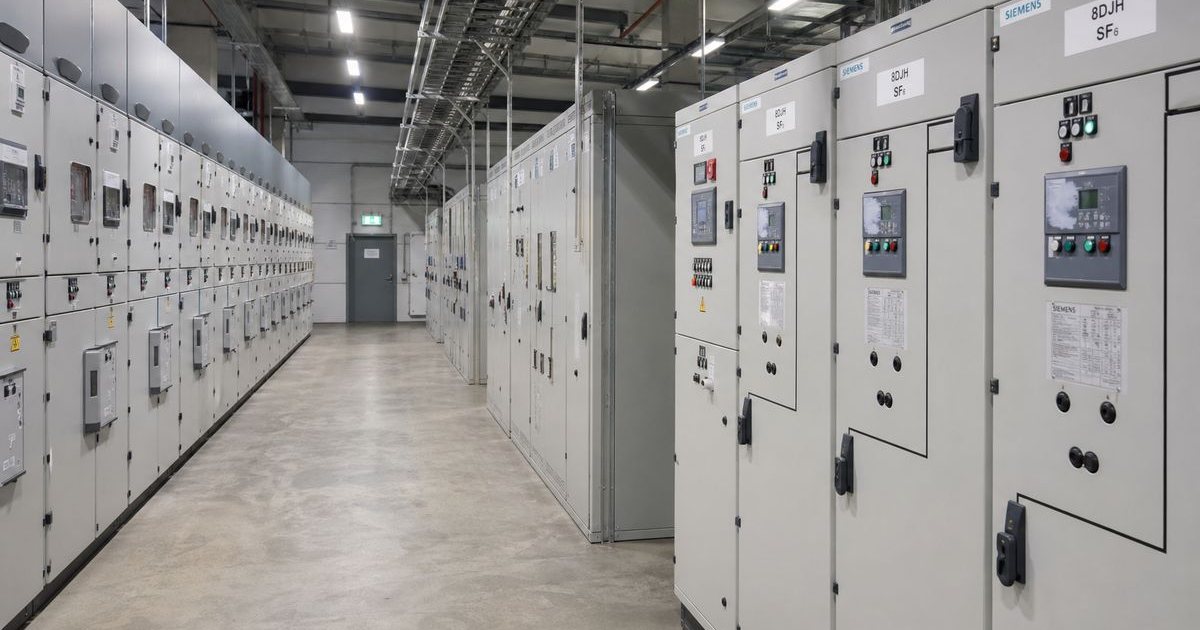
Quick Answer: What Changes Above 1,000 m
Air is your insulator. At altitude there is less of it, so it insulates less well. IEC 62271-1 sets 1,000 m as the upper limit of normal service conditions; above that, the rated insulation levels of any equipment with external insulation in atmospheric air must be multiplied by the altitude correction factor:
Ka = e[m x (H - 1000) / 8150] (m = 1 for power-frequency and lightning impulse)
Three things change, and three things do not:
- Changes a lot — external dielectric withstand. Down roughly 22% at 3,000 m, 35% at 4,500 m. This is what drives the cost.
- Changes a little — current-carrying capacity. Thinner air cools less well. Typically a 1-4% penalty, often cancelled by the lower ambient temperature at altitude.
- Changes quietly — auxiliary and monitoring devices. SF6 density gauges, spring-charging motors, LV arc chutes and fans all behave differently. Nobody specifies these, and they are where the field problems actually appear.
- Does not change — internal insulation. The vacuum inside a vacuum interrupter, the gas inside a sealed GIS tank, the epoxy in a cast pole. Their dielectric behaviour is identical at 5,000 m and at sea level.
- Does not change — creepage requirements. Creepage distance is driven by pollution severity, not air density. Altitude and pollution are separate specifications that get conflated constantly.
- Does not change — short-circuit withstand. Making and breaking capacity, peak withstand, 1-second thermal rating: all unaffected by altitude.
The practical consequence for most buyers is a single decision: step up one or two standard insulation classes, or change insulation technology. The tables below tell you which.

Why Air Stops Insulating: The Physics in One Paragraph
Dielectric breakdown in air is an avalanche process. A free electron accelerates in the electric field, collides with a gas molecule, and if it has gained enough energy between collisions it ionises that molecule and releases another electron. The controlling variable is the mean free path — how far an electron travels between collisions. At lower air density the mean free path is longer, the electron arrives at each collision with more energy, and the avalanche starts at a lower applied voltage. This is Paschen behaviour, and it is why the correction depends on air density rather than on altitude as such.
Two engineering consequences follow directly and are worth internalising:
- The correction is exponential, not linear. The frequently quoted rule of thumb "1% per 100 m" is a linear approximation of an exponential curve. It is acceptable to about 2,000 m and progressively wrong above that. At 4,500 m the rule of thumb predicts a 35% increase; the actual factor is 53.6%. Do not specify plateau equipment off the rule of thumb.
- Only air gaps count. If the dielectric is not atmospheric air — vacuum, sealed SF6, cast epoxy, dry-air-filled sealed tank — the density does not change with altitude and neither does the withstand capability. This is the lever that makes high-altitude projects affordable.
The IEC Altitude Correction Factor (Ka): Full Table
IEC 62271-1 adopts the altitude correction of IEC 60071-2. For medium-voltage equipment, m = 1 applies to the two withstand levels you actually specify: the 1-minute power-frequency withstand voltage and the lightning impulse withstand voltage.
| Altitude (m) | Ka (IEC) | 1/Ka (equivalent ANSI-style derate) | 12 kV class needs PF (kV) | 12 kV class needs LIWV (kV) | 24 kV class needs PF (kV) | 24 kV class needs LIWV (kV) |
|---|---|---|---|---|---|---|
| 1,000 (reference) | 1.000 | 1.000 | 28.0 | 75.0 | 50.0 | 125.0 |
| 1,500 | 1.063 | 0.940 | 29.8 | 79.7 | 53.2 | 132.9 |
| 2,000 | 1.131 | 0.885 | 31.7 | 84.8 | 56.5 | 141.3 |
| 2,500 | 1.202 | 0.832 | 33.7 | 90.2 | 60.1 | 150.3 |
| 3,000 | 1.278 | 0.782 | 35.8 | 95.9 | 63.9 | 159.8 |
| 3,500 | 1.359 | 0.736 | 38.1 | 101.9 | 67.9 | 169.9 |
| 4,000 | 1.445 | 0.692 | 40.5 | 108.4 | 72.2 | 180.6 |
| 4,500 | 1.536 | 0.651 | 43.0 | 115.2 | 76.8 | 192.1 |
| 5,000 | 1.634 | 0.612 | 45.7 | 122.5 | 81.7 | 204.2 |
Computed from Ka = e^[(H-1000)/8150] with m = 1. Base values are the IEC standard rated insulation levels: 12 kV class = 28 kV / 75 kV; 24 kV class = 50 kV / 125 kV. See our guide to circuit breaker kV and kA ratings for how these base levels are assigned.
Which Standard Insulation Class Do You Actually Need?
This is the table buyers want and almost never get. The IEC medium-voltage insulation ladder is fixed: 7.2 kV (20/60), 12 kV (28/75), 17.5 kV (38/95), 24 kV (50/125), 36 kV (70/170), 40.5 kV (95/185). Given a system voltage and an altitude, the question is simply which rung clears both corrected requirements.
| Site altitude | 12 kV system needs... | 24 kV system needs... | Comment |
|---|---|---|---|
| ≤ 1,000 m | 12 kV class | 24 kV class | No correction. Standard product. |
| 1,500 m | 17.5 kV class | 36 kV class | One step up. Usually a catalogue item. |
| 2,000 m | 17.5 kV class | 36 kV class | Covers Mexico City, Addis Ababa, Nairobi. |
| 2,500 m | 17.5 kV class | 36 kV class | Covers Bogota, Quito, Arequipa. |
| 3,000 m | 24 kV class | 36 kV class | 17.5 kV falls ~1% short on LIWV. Do not accept it. |
| 3,500 m | 24 kV class | 40.5 kV class | Cusco, Andean mining access. |
| 4,000 m | 24 kV class | 40.5 kV class | Top of the standard ladder for 24 kV. |
| 4,500 m | 24 kV class | No standard class exists | Purpose-designed plateau equipment or GIS/SIS only. |
| 5,000 m | 24 kV class | No standard class exists | Same. Plan the technology change early. |
Two findings in this table are worth more than the rest of this article:
First: a 12 kV system needs exactly one jump, and it holds all the way to 5,000 m. Once you are at 24 kV-class insulation you have covered every inhabited altitude on Earth for a 12 kV network. There is no benefit in specifying a graduated series of altitude-specific designs for 12 kV projects, and no reason to pay for a custom engineering exercise. This is genuinely good news and it is why most of our plateau orders are a single standard uprated product.
Second: a 24 kV system runs out of ladder at about 4,000 m. Above that, the corrected lightning impulse requirement (192 kV at 4,500 m) exceeds the 185 kV of the 40.5 kV class, which is the top of the IEC MV range. There is nothing left to step up to. Projects that discover this at the purchase-order stage lose months. Andean copper, lithium and molybdenum projects sit squarely in this band — see our guide to switchgear for mining applications.
Six Real Sites: What We Quote for Each
These are altitudes we quote against regularly. Assume a 12 kV distribution system unless noted.
| Site | Altitude | Ka | Corrected requirement (12 kV) | What we supply |
|---|---|---|---|---|
| Denver, USA | 1,609 m | 1.077 | 30.2 / 80.8 kV | 17.5 kV class AIS. Trivial uprate. |
| Johannesburg, South Africa | 1,753 m | 1.097 | 30.7 / 82.3 kV | 17.5 kV class AIS. |
| Mexico City, Mexico | 2,240 m | 1.164 | 32.6 / 87.3 kV | 17.5 kV class AIS, standard cubicle. |
| Addis Ababa, Ethiopia | 2,355 m | 1.181 | 33.1 / 88.6 kV | 17.5 kV class AIS. |
| Bogota, Colombia | 2,640 m | 1.223 | 34.2 / 91.7 kV | 17.5 kV class, checked against LIWV margin. |
| El Alto / La Paz, Bolivia | 4,050 m | 1.454 | 40.7 / 109.0 kV | 24 kV class AIS, or GIS if footprint matters. |
| Andean mine site (typical) | 4,500 m | 1.536 | 43.0 / 115.2 kV | 24 kV class for 12 kV; GIS/SIS for anything at 24 kV. |
Notice how flat the commercial picture is for 12 kV: everything from Denver to Bogota is one catalogue step, and everything from Bogota to a 4,500 m mine is two. The engineering drama is concentrated entirely in the 24 kV and 33 kV collector networks — which is exactly where solar and wind projects at altitude operate.
IEC vs ANSI/IEEE: Why the Numbers Look Opposite
This confuses more projects than the physics does. The two standard families describe the same effect from opposite ends:
- IEC uprates the requirement. Ka > 1. "At 3,000 m, your 12 kV equipment must withstand 35.8 kV / 95.9 kV."
- ANSI/IEEE derates the equipment. Correction factor < 1. "At 3,000 m, this sea-level-rated equipment retains 80% of its BIL."
They are reciprocals of each other, and they agree closely:
| Altitude | IEC Ka | 1/Ka | ANSI/IEEE dielectric factor | Agreement |
|---|---|---|---|---|
| 1,500 m | 1.063 | 0.940 | 0.95 | within 1.1% |
| 3,000 m | 1.278 | 0.782 | 0.80 (commonly tabulated) | within 2.3% |
ANSI/IEEE C37.30 gives 0.95 dielectric, 0.99 current and 0.98 temperature at 1,500 m. Always confirm against the current edition of the applicable C37 standard for your equipment type; the tabulated values differ slightly between C37.20.2 (metal-clad switchgear), C37.30 (switches) and C37.010 (breaker application).
The failure mode to avoid: applying both corrections. We regularly receive specifications that ask for ANSI-derated equipment and IEC Ka-uprated withstand levels for the same panel. That double-counts the altitude, pushes a 12 kV project into 36 kV-class hardware, and adds cost for no dielectric benefit. Pick one standard family and state it explicitly. Our IEC 62271 standards guide covers how the parts of the series fit together.
Current Rating and Temperature Rise: The Second Derating
Lower air density means lower convective heat transfer, so the same busbar current produces a higher temperature rise. Two points make this far less alarming than the dielectric derating:
The penalty is small. The ANSI/IEEE correction at 1,500 m is 0.99 for current against 0.95 for dielectric — a 1% current penalty against a 5% dielectric penalty. Radiation and conduction are unaffected by air density, and they carry a meaningful share of the heat out of an MV cubicle.
The penalty is frequently cancelled by ambient temperature. IEC 62271-1 rates temperature rise against a maximum ambient of 40 degC with a 24-hour mean not exceeding 35 degC. High-altitude sites are almost always cold: El Alto rarely exceeds 20 degC, and Andean mine sites routinely specify a maximum ambient of 25 degC. Every degree of ambient headroom you have is directly available to offset the convective loss, and at typical plateau ambients you recover more than you lost.
What we do in practice: we do not apply a blanket current derate. We ask for the site maximum ambient and the 24-hour mean, and we run the temperature-rise calculation at the actual air density and the actual ambient. On most plateau projects the busbar comes out the same size as the sea-level design or one step smaller, not larger. If a supplier quotes you a large current derate at altitude without asking for your ambient temperatures, they are guessing.
Two secondary effects that do deserve attention:
- Forced ventilation loses efficiency. A fan moves a fixed volume, not a fixed mass. At 4,000 m the same fan removes roughly 40% less heat. Naturally cooled designs are more predictable at altitude than forced-cooled ones.
- Spring-charging motors and LV auxiliaries run hotter. These are usually the first components to fail on an uncorrected plateau installation, long before any dielectric problem appears.
What Is Not Affected by Altitude (Stop Paying For It)
Supplier quotations for high-altitude projects are frequently padded with corrections that have no physical basis. None of the following change with altitude:
| Parameter | Affected? | Why |
|---|---|---|
| Vacuum interrupter internal withstand | No | Vacuum is vacuum. The interrupter is a sealed unit at any elevation. |
| Sealed GIS / solid-insulated internal withstand | No | IEC is explicit: internal insulation needs no altitude correction. |
| Short-circuit breaking and making capacity | No | Determined by the interrupter, not by ambient air. |
| Peak and 1-second thermal withstand | No | Conductor cross-section and material properties. |
| Creepage distance requirement | No | Driven by pollution severity per IEC TS 60815, not air density. |
| Mechanical endurance class (M1/M2) | No | Mechanism life is unrelated to air density. |
| Internal arc classification (IAC) | Qualified | The pressure-relief behaviour differs at lower ambient pressure; ask whether the IAC type test is valid for your altitude rather than assuming it transfers. |
| External air clearances | Yes | This is the whole of the altitude problem. |
The creepage line is the one most worth arguing about with a supplier. Creepage is a pollution specification. A clean indoor room at 4,000 m needs the same creepage as a clean indoor room at sea level, while a coastal site at 50 m may need far more than either. Conflating them adds cost and, more annoyingly, adds physical size to a cubicle you were probably already fitting into a tight substation.
The Cheapest Way Out Is Usually Not a Bigger AIS Panel
Most articles on this subject stop at "multiply by Ka." Here is the part that affects your budget. There are four routes to a compliant high-altitude installation, and the obvious one is rarely the best.
- Step up the insulation class (air-insulated). Simple, catalogue-based, no engineering risk. Cost premium is modest for one step. The hidden cost is physical size: bigger air clearances mean a wider and deeper cubicle, and above 3,000 m a 12 kV lineup carrying 24 kV-class insulation may no longer fit the substation building the civil team already designed. Check the footprint before you check the price.
- Change to gas-insulated or solid-insulated technology. The correction then applies only to the external bushings and cable terminations, not to the entire internal geometry. Above roughly 3,000 m this frequently costs less in total installed terms than an uprated AIS lineup, because the building shrinks. See our gas-insulated switchgear guide and the GSN3-12 and GSN1-40.5L GIS range.
- Pressurise or seal the enclosure. Viable for specific applications, but it converts a passive asset into one with a maintained pressure system. We rarely recommend it for distribution-class projects.
- Move the equipment down the hill. Sounds facetious; it is not. On mining projects the main intake substation is often sited by habit at the process plant. Relocating it 600 m lower down the access road can drop you a full insulation class, and the cost of the extra MV cable is frequently less than the cost of the uprated switchgear plus the enlarged building. We have had customers save real money on this and it is not in any supplier catalogue, because no supplier profits from suggesting it.
Route 4 is the one nobody will tell you about. Ask your civil and electrical teams to price it before you accept a plateau premium.
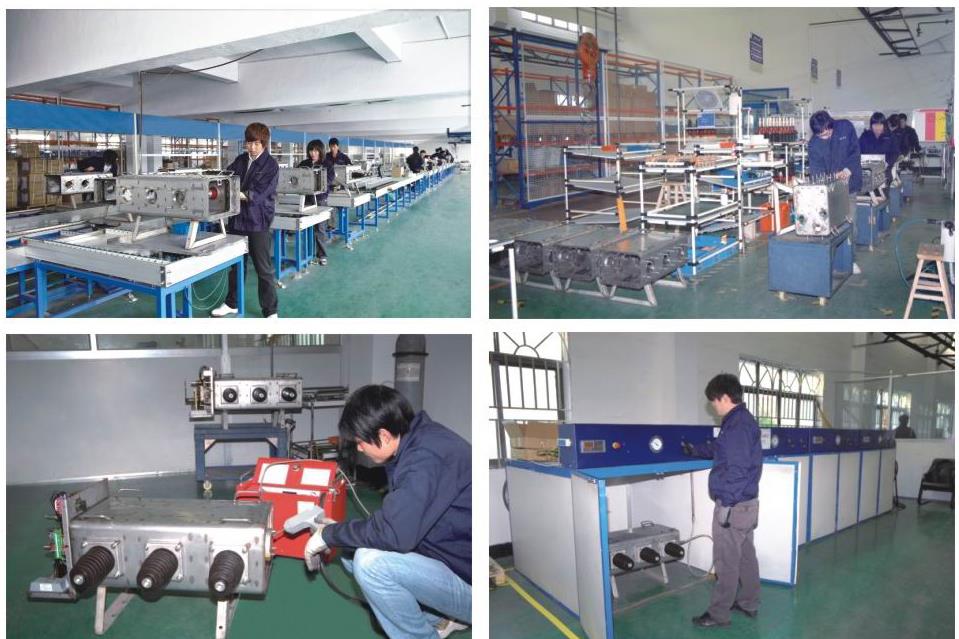
How We Build Plateau-Type Switchgear
China operates one of the largest high-altitude grids in the world — the Qinghai-Tibet networks run above 4,000 m across hundreds of kilometres — so plateau-type MV equipment is an ordinary product category here rather than a special-engineering exercise. The domestic standard governing it, GB/T 20635, "Special environmental conditions — Technical requirements for high-voltage apparatus for plateaus," covers altitudes from above 1,000 m up to 5,000 m and applies to circuit breakers, disconnectors, load break switches, earthing switches, fuses and surge arresters. (Note for spec writers: the 2006 edition was withdrawn in December 2017, so a supplier still citing "GB/T 20635-2006" on a datasheet is quoting a superseded document — ask which current edition their type tests were performed to.)
What changes on our production floor for a plateau order:
- Enlarged phase-to-phase and phase-to-earth clearances in the air-insulated compartments, dimensioned from the corrected withstand levels rather than from the nominal class.
- Type test at the corrected level. A plateau panel is tested to the uprated power-frequency and lightning impulse values, not to the 12 kV class values with a paper note attached. Ask for the test report, and check that the values on it are the corrected ones.
- Absolute-pressure-referenced, temperature-compensated SF6 density monitors on gas-filled products. A gauge-pressure instrument reads high at altitude and will hide a slow leak for years.
- Derated auxiliary components — spring-charging motor, heaters, contactors, any LV device with an arc chute — selected against the site air density rather than carried over from the sea-level bill of materials.
- Temperature rise verified at the site ambient, using the customer-supplied maximum and 24-hour mean.
Our ASN-series metal-enclosed switchgear and indoor vacuum circuit breakers are available in altitude-corrected configurations; the GIS range is usually the better answer above 3,000 m.
Copy-Paste RFQ Block for High-Altitude Projects
Paste this into your enquiry. It takes one minute and removes the three questions that otherwise add a week to every quotation round:
Site and service conditions
Installation altitude: _____ m above sea level
Maximum ambient temperature: _____ degC | Minimum: _____ degC | 24-hour mean maximum: _____ degC
Standard family to apply for altitude correction: IEC 62271-1 (Ka) or ANSI/IEEE C37 — one only, not both
System voltage: _____ kV | Required rated current: _____ A | Short-circuit: _____ kA / _____ s
Pollution severity per IEC TS 60815 (this is separate from altitude): _____
Indoor or outdoor: _____ | Maximum available footprint (W x D x H): _____
Required from supplier: type test report showing the altitude-corrected power-frequency and lightning impulse withstand values; confirmation of whether the IAC type test is valid at the stated altitude; SF6 density monitor type (absolute vs gauge reference) if gas-filled.
The footprint line matters more than people expect — see the size warning in the section above. For a fuller checklist, our MV switchgear specification and RFQ guide covers the rest of the datasheet.
Quoting a Project Above 1,000 m?
Send us your altitude, ambient temperature range, system voltage and fault level, and we will come back with the corrected withstand requirement, the insulation class we recommend, the resulting cubicle footprint, and a price — typically within 24 hours. If stepping up a class does not fit your building, we will tell you what the gas-insulated alternative costs instead of quietly quoting the bigger box.
Contact NAIJI Electric — medium-voltage switchgear and circuit breakers since 2001, factory direct, 30-60 day delivery, altitude-corrected configurations to 5,000 m.
Related guides: IEC 62271 Standards Explained | Switchgear for Mining Applications | Gas-Insulated Switchgear Guide | Circuit Breaker Ratings Explained | MV Switchgear Specification & RFQ Guide