Quick Answer: What Metal-Enclosed Switchgear Is and When to Specify It
Metal-enclosed switchgear is medium voltage switchgear in which the circuit breakers or switches, busbars, instrument transformers and protection relays all sit inside a grounded metal enclosure. That enclosure does two jobs: it keeps people away from live parts, and it gives an internal arc fault a defined, tested path to vent. It is governed by IEC 62271-200 internationally (1 kV to 52 kV) and by ANSI/IEEE C37.20.3 in North America for metal-enclosed interrupter switchgear (1 kV to 48.3 kV). Specify it wherever medium voltage equipment is installed in an occupied building — which in practice means almost every industrial plant, commercial building, hospital and utility substation.
The Definition, Precisely
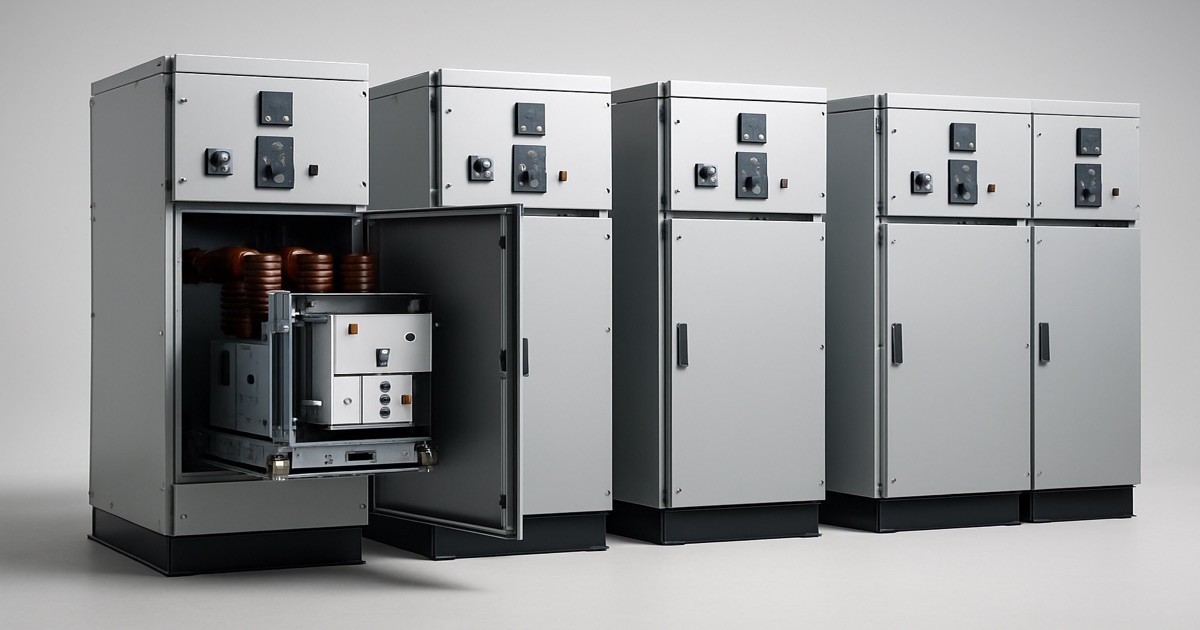
Confusion around this term is common because two standards systems define it differently, and salespeople use the words loosely.
Under IEC 62271-200, "metal-enclosed switchgear and controlgear" is the umbrella category for all AC switchgear assemblies from 1 kV to 52 kV that have an external metallic enclosure intended to be earthed, and which are completely assembled except for external connections. Everything from a simple ring main unit to a fully compartmented drawout lineup is metal-enclosed under IEC. The standard then subdivides by loss of service continuity and partition class, which we cover below.
Under the ANSI/IEEE system, the words carry a narrower meaning. Three separate standards apply:
- IEEE C37.20.2 — Metal-Clad and Station-Type Cubicle Switchgear. Drawout breakers, full compartment barriers, automatic shutters.
- IEEE C37.20.3 — Metal-Enclosed Interrupter Switchgear, rated above 1 kV up to and including 48.3 kV AC (2023 edition). Interrupter switches and power fuses, usually fixed-mounted.
- IEEE C37.20.1 — Metal-Enclosed Low-Voltage Power Circuit Breaker Switchgear (below 1 kV).
So when a North American specification says "metal-enclosed switchgear per C37.20.3", it means specifically an interrupter switch and fuse assembly — not a drawout breaker lineup. When an IEC-based specification says "metal-enclosed switchgear per IEC 62271-200", it could mean either, and you have to read the LSC and partition class to know which. This single ambiguity causes more quotation mismatches in our export business than any other specification issue.
How a Metal-Enclosed Bay Is Built
A standard air-insulated metal-enclosed bay is divided into four functional compartments. Understanding the layout makes the classification tables that follow much easier to read.
| Compartment | Contents | Typical Access | Why It Matters |
|---|---|---|---|
| Busbar | Main three-phase busbar, bus supports, branch connections | Rear or top, rarely opened | Sets the lineup's continuous current and short-time withstand rating |
| Circuit breaker | Vacuum circuit breaker on a drawout truck or fixed mount | Front door | Determines breaking capacity and operating duty |
| Cable / connection | Cable terminations, current transformers, earthing switch, surge arresters | Front or rear panel | Determines how many and how large a cable you can terminate |
| Low voltage | Protection relay, meters, control wiring, MCBs, terminal blocks | Front, top of bay | Isolated from MV; can be worked on while the bay is live |
Above the busbar and cable compartments, pressure relief flaps vent the gases produced by an internal arc upward — into a duct or a plenum, away from the operator standing at the front. The presence, strength and direction of that venting path is exactly what an internal arc test verifies.
Fixed-Mounted vs Drawout
Two mounting philosophies exist, and the choice affects maintenance far more than it affects performance.
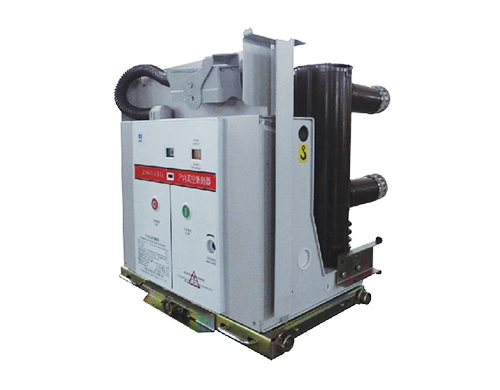
- Drawout (withdrawable): the breaker sits on a truck that racks between service, test and isolated positions. Maintenance means racking the breaker out and rolling it away — the bay itself can often be restored to service with a spare truck within an hour. Standard for utility and critical industrial installations.
- Fixed-mounted: the breaker is bolted in place. Cheaper by roughly 10-20% per bay and mechanically simpler, but any breaker maintenance requires a full outage of that bay with the cable and busbar isolated and earthed. Common in secondary distribution, ring main units and cost-driven projects.
NAIJI's ASN3-12 and ASN2-24 use drawout construction with a three-position truck and full mechanical interlocking; the compact ASN550 is available in both configurations.
IEC 62271-200 Classification: LSC and Partition Class
This is the part of the standard that engineers most often skip and most often regret skipping. IEC 62271-200 does not use the words "metal-clad" at all. Instead it asks two practical questions: how much of the installation must be switched off to work on one compartment, and what are the internal partitions made of.
| Class | What It Means in Practice | Busbar Stays Live? | Adjacent Cable Compartment Stays Live? | Typical Application |
|---|---|---|---|---|
| LSC1 | Opening one compartment requires de-energizing others | No | No | Small secondary substations, cost-driven projects |
| LSC2A | Busbar stays energized while working in the breaker or cable compartment of that unit | Yes | No | General industrial distribution |
| LSC2B | Busbar and the cable compartments of adjacent units all stay energized | Yes | Yes | Utility substations, hospitals, data centres, continuous process |
The partition class is a separate letter appended to the LSC class:
- PM (Partial Metallic): partitions and shutters between compartments are metallic and earthed. Highest integrity.
- PI (Partial Insulating): some partitions are insulating material rather than earthed metal. Acceptable but less robust under internal arc conditions.
The practical takeaway: LSC2B PM is the IEC construction that most closely corresponds to ANSI metal-clad. If your specification was written against C37.20.2 metal-clad and you are buying to IEC, write "LSC2B, PM partition class, IAC AFLR" into the enquiry. If you write only "metal-enclosed switchgear", you may receive a perfectly compliant LSC1 quotation at 30% less money and no shutters — and the mismatch will not surface until the factory acceptance test. Our detailed metal-clad vs metal-enclosed comparison works through both naming systems side by side.
Ratings: What Each Number on the Nameplate Controls
Six ratings define a metal-enclosed assembly. Every one of them has a cost consequence, so specify them deliberately rather than copying an old datasheet.
| Rating | Symbol | Common Values | What It Governs |
|---|---|---|---|
| Rated voltage | Ur | 7.2 / 12 / 24 / 36 / 40.5 kV | Clearances, insulation, bay dimensions |
| Rated insulation level | Ud / Up | 28/75, 50/125, 70/170, 95/185 kV | Power-frequency and lightning impulse withstand |
| Rated continuous current | Ir | 630 / 1250 / 1600 / 2500 / 3150 / 4000 / 5000 A | Busbar cross-section, contact size, temperature rise |
| Rated short-time withstand current | Ik | 20 / 25 / 31.5 / 40 / 50 kA for 1 s or 3 s | Mechanical bracing of busbar and supports |
| Rated peak withstand current | Ip | 2.5 × Ik (50 / 63 / 80 / 100 / 125 kA) | Electrodynamic force the structure survives |
| Internal arc classification | IAC | IAC A FLR 31.5 kA 1 s | Personnel protection during an internal arc fault |
A worked example of how these connect: a 12 kV lineup rated 31.5 kA for 1 s must have a peak withstand of about 80 kA, since Ip = 2.5 × Ik at 50 Hz per IEC 62271-1. That peak figure — not the RMS one — is what determines how many busbar supports the manufacturer fits and how thick the bracing is. Specifying 40 kA "for margin" when your fault level is 25 kA is not free; it typically adds 8-15% to the bay price and can add busbar supports that reduce cable termination space.
Internal Arc Classification, Decoded
An internal arc fault is the failure mode that kills people. An arc inside a switchgear enclosure reaches roughly 20,000 K, and the resulting pressure wave and hot gas will breach an untested enclosure. IEC 62271-200 Annex AA defines a type test in which an arc of specified current is deliberately struck inside the assembly and cotton indicators are placed around it to detect escaping hot gas.
The classification code reads like this: IAC AFLR 31.5 kA 1 s
- IAC — internal arc classified
- A — accessibility restricted to authorized personnel (B means public accessibility, a stricter case)
- F, L, R — the accessible sides that were tested and protected: Front, Lateral, Rear. A front-only design would be
IAC AF. - 31.5 kA 1 s — the arc current and duration withstood
Two practical rules from building this equipment: first, the duration must be at least your protection clearing time plus a margin — if the busbar protection clears in 300 ms, 0.5 s is defensible and 1 s is safer. Second, an internal arc classification is only valid for the tested configuration, including the exhaust arrangement. If the type test used a roof duct and your installation vents into the room, the classification does not carry over. Confirm the ducting arrangement with the manufacturer at the drawing stage.
Metal-Enclosed vs the Alternatives
Air-insulated metal-enclosed switchgear is the default choice, but it is not the only one. Here is the honest comparison.
| Option | Footprint (12 kV bay) | Indicative FOB Price | Maintenance Interval | Best Suited To |
|---|---|---|---|---|
| Air-insulated metal-enclosed | 800-1000 mm wide × 1400-1600 mm deep | $2,800 - $8,000 | 5-8 years | Standard indoor distribution — the default |
| Compact metal-enclosed | 600-800 mm wide × 550-900 mm deep | $3,200 - $8,500 | 5-8 years | Retrofits and space-limited switchrooms |
| Gas-insulated (GIS) | 600-800 mm wide × 800-1000 mm deep | $8,000 - $20,000 | 10+ years, sealed for life | Severe space limits, high humidity, coastal or dusty sites |
| Ring main unit | Compact 3-way unit, ~1200 mm wide total | $2,000 - $5,000 | 10+ years | Secondary distribution, ring feeders, compact substations |
Where floor space is the binding constraint, the ASN550 at 550 mm depth recovers 30-45% of switchroom depth relative to a conventional 1000 mm bay, which is frequently the difference between reusing an existing building and constructing a new one. Where the environment is the constraint — coastal salt, high humidity, heavy dust — sealed gas-insulated switchgear is worth its premium, and modern SF6-free designs remove the greenhouse gas objection.
Metal-Enclosed Switchgear Pricing (2026)
Indicative FOB China prices, air-insulated, 31.5 kA, drawout vacuum circuit breaker, standard indoor enclosure:
| Configuration | Voltage | Rated Current | Price per Bay (FOB) |
|---|---|---|---|
| Feeder bay, VCB | 12 kV | 630-1250 A | $2,800 - $6,500 |
| Incomer bay with metering | 12 kV | 1250-3150 A | $4,500 - $9,000 |
| Bus coupler bay | 12 kV | Matched to bus | $3,500 - $7,000 |
| Feeder bay, VCB | 24 kV | 630-1250 A | $5,000 - $12,000 |
| Feeder bay, VCB | 40.5 kV | 1250-3150 A | $8,000 - $18,000 |
| Complete 8-bay lineup | 12 kV | Mixed | $25,000 - $65,000 |
Cost drivers, ranked by how much they actually move the number: voltage class first, then rated current, then short-circuit rating, then internal arc classification and enclosure type, then the protection relay brand — a European-brand numerical relay can add $800-$2,500 per bay over a comparable regional product. Orders above 20 bays typically attract 10-15% volume pricing.
Specification Checklist
Sending this list with an enquiry is the fastest route to an accurate quotation. Every missing line becomes an assumption, and assumptions become variation orders.
- Applicable standard: IEC 62271-200 / IEEE C37.20.3 / IEEE C37.20.2 / GB 3906
- Rated voltage and system voltage; frequency
- Rated insulation level (power frequency / lightning impulse)
- Rated continuous current of busbar and of each bay
- Rated short-time withstand current and duration (e.g. 31.5 kA, 1 s)
- LSC class and partition class (e.g. LSC2B, PM)
- Internal arc classification with accessible sides and duration (e.g. IAC AFLR 31.5 kA 1 s)
- Fixed-mounted or drawout main device
- Bay schedule: type, quantity, single-line diagram
- Cable data: type, cross-section, cables per phase, entry from top or bottom
- Protection relay make, model and communication protocol (IEC 61850 / MODBUS / DNP3)
- Environment: indoor/outdoor, altitude, ambient temperature range, humidity, pollution level, seismic requirement
- Auxiliary supply voltage (DC 110 V / 220 V, or AC)
- Degree of protection required (IP4X indoor, IP54 outdoor)
- Test documentation required: type test reports, routine test records, FAT witness
Type Tests vs Routine Tests: What to Ask a Supplier For
This distinction matters commercially, because a supplier can truthfully say "our switchgear is fully tested" while meaning two very different things.
- Type tests are performed once per design at an accredited high-power laboratory: short-time withstand current, peak withstand, temperature rise, dielectric, internal arc, mechanical endurance, IP verification, and EMC on the control circuits. Ask for the reports by design and confirm they cover your rating combination, not a smaller one.
- Routine tests are performed on every assembly before it leaves the factory, per IEC 62271-200 clause 7: power-frequency withstand on the main circuit, dielectric test on auxiliary circuits, main circuit resistance measurement, wiring verification against the schematic, mechanical operation and interlock verification, and visual inspection. Ask for the routine test record listing your serial numbers.
For international projects we recommend nominating a factory acceptance test in the purchase order — either witnessed on site or by video with the routine test sheets countersigned. Finding an interlock error at the factory costs an afternoon; finding it at site costs a container round trip. Our guide to switchgear testing standards and procedures covers the full test sequence.
NAIJI Metal-Enclosed Switchgear Range
NAIJI Electric manufactures air-insulated metal-enclosed switchgear across the full medium voltage range, type-tested to IEC 62271-200 at accredited laboratories, with production capacity above 3,000 bays per year:
- ASN3-12 — 12 kV, up to 5000 A, 50 kA short-time withstand, internal arc 50 kA/1 s, qualified to 4,500 m altitude and AG3 vibration class
- ASN2-24 — 24 kV, up to 4000 A, 40 kA, internal arc 31.5 kA/0.5 s
- ASN1-40.5(G) — 40.5 kV, up to 3150 A, 40 kA, unusually compact for its voltage class
- ASN550 — 550 mm depth compact design, up to 1250 A / 31.5 kA, for retrofits and constrained switchrooms
- ASN3i-12 — intelligent version with IEC 61850 communication, partial discharge and temperature monitoring for condition-based maintenance
Breakers are supplied from our own indoor vacuum circuit breaker range, so the truck, interlocks and bay are engineered as one assembly rather than integrated from third-party parts. Standard configurations ship in 4-6 weeks; project-specific lineups in 8-12 weeks.
Frequently Asked Questions
What is metal-enclosed switchgear?
A medium voltage assembly in which switching devices, busbars, instrument transformers and protection equipment are housed inside a grounded metal enclosure that provides both personnel protection and a tested fault-containment boundary. IEC 62271-200 covers 1-52 kV; ANSI/IEEE C37.20.3 covers metal-enclosed interrupter switchgear from 1 kV to 48.3 kV.
What is the difference between metal-enclosed and metal-clad?
Metal-clad is a stricter subset. It requires a drawout main device, grounded metal barriers between all major compartments, automatic shutters over the primary bushings, insulated primary bus, and mechanical interlocks. Metal-enclosed only requires the grounded enclosure and may use fixed-mounted devices with fewer barriers and no shutters.
What does LSC2B PM mean?
LSC2B is the highest Loss of Service Continuity category in IEC 62271-200: the busbar and the cable compartments of adjacent functional units can stay energized while you work in one compartment. PM means Partial Metallic partitions — internal barriers and shutters are earthed metal. LSC2B PM is the closest IEC construction to ANSI metal-clad.
How much does metal-enclosed switchgear cost?
Indicative FOB China per bay at 31.5 kA: 12 kV feeder $2,800-$6,500; 12 kV incomer with metering $4,500-$9,000; 24 kV feeder $5,000-$12,000; 40.5 kV feeder $8,000-$18,000. A complete 8-bay 12 kV lineup runs $25,000-$65,000.
What internal arc classification should I specify?
Write it as a full code, for example IAC AFLR 31.5 kA 1 s. Match the current to your prospective short-circuit level, the duration to your protection clearing time plus margin, and list every accessible side (F front, L lateral, R rear). Confirm the tested exhaust arrangement matches your installation — the classification is only valid for the configuration that was tested.
Can it be installed outdoors?
Yes, with an outdoor enclosure rated IP54 or better, weatherproof seals, anti-condensation heaters with hygrostat control, and a corrosion-protected paint system. Expect 20-35% higher equipment cost than the indoor equivalent, and consider a walk-in aisle so operators are sheltered.
What tests are done before shipment?
Routine tests per IEC 62271-200 clause 7 on every assembly: power-frequency withstand on the main circuit, dielectric test on auxiliary circuits, main circuit resistance measurement, wiring verification, mechanical operation and interlock checks, and visual inspection. Type tests (short-time withstand, temperature rise, internal arc, IP) are done once per design. Request both the type test reports and the routine test record for your serial numbers.
How long does it last?
Design life is 25-30 years. Vacuum interrupters are rated for 10,000-30,000 mechanical operations and 20-50 full short-circuit interruptions. In practice the operating mechanism, auxiliary contacts and relay electronics need attention around year 15. Standard maintenance is annual visual inspection plus a detailed inspection every 5-8 years.
Request a Metal-Enclosed Switchgear Quotation
Send your bay schedule and single-line diagram, or just the specification checklist above, and our engineering team will return a technical proposal with drawings and pricing.
Minimum information for an accurate quotation:
- Rated voltage, frequency and rated current
- Short-time withstand current and duration
- LSC class, partition class and internal arc classification
- Bay schedule by type and quantity
- Cable data and entry direction
- Protection relay preference and communication protocol
- Installation environment: indoor/outdoor, altitude, ambient range
Request a Switchgear Quotation →
Related guides: Metal-Clad vs Metal-Enclosed | MV Switchgear Types & Selection | Switchgear Testing Standards | Switchgear Lineup Design | MV Distribution System Design | Gas-Insulated Switchgear Guide